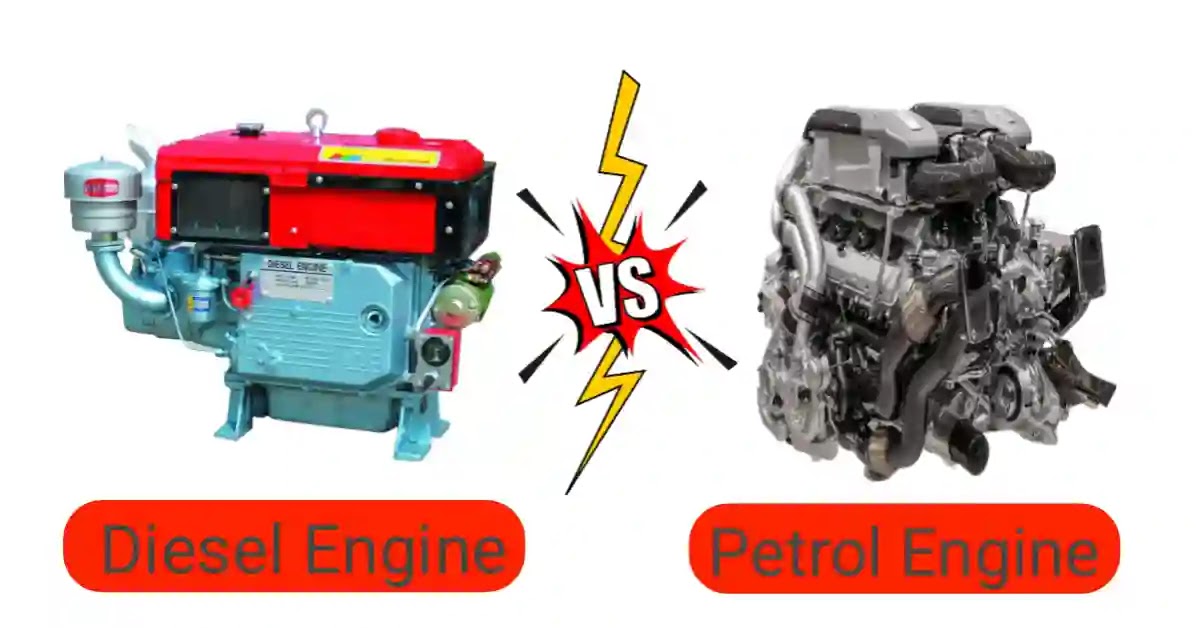

Difference Between Petrol Engine and Diesel Engine:
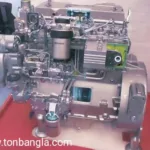
Diesel Engine: Diesel Engine or Compression or Ignition Engine In a diesel engine, the air inside the cylinder is compressed to very high pressure (40-45 kg/sq cm).The high pressure causes the compressed air to heat up to almost red hot or 600°C. In this condition, diesel fuel is injected into the vaporizer at a higher pressure.The fuel is ignited instantly by the high heat of the compressed air.
Detailed difference between Diesel Engine and Petrol Engine:
Detailed differences between Diesel and Petrol Engines are given below:-
table.GeneratedTable {
width: 100%;
background-color: #ffffff;
border-collapse: collapse;
border-width: 1px;
border-color: #ff00ff;
border-style: solid;
color: #000000;
}
table.GeneratedTable td, table.GeneratedTable th {
border-width: 1px;
border-color: black;
border-style: solid;
padding: 3px;
}
table.GeneratedTable thead {
background-color: #ffff00;
}
| Serial No | Diesel Engine | petrol engine |
|---|---|---|
| 1 | The cylinder only takes air and does not require a carburetor. | The cylinder receives a mixture of fuel (petrol) and air. A carburetor creates a mixture of petrol and air. |
| 2 | Fuel is injected through injectors to ignite compressed air. | The compressed mixture is ignited by an electric spark plug. |
| 3 | Diesel is used as fuel. | Petrol is used as fuel. |
| 4 | The ratio of air to fuel is not fixed. | The ratio of air to fuel is usually constant and is 15:1. |
| 5 | Combustion does not require electricity or electrical sparking. | Combustion requires electricity or electrical sparking. |
| 6 | Compression ratio from 14:1 to 20:1. | Compression ratio from 4:1 to 8:1. |
| 7 | Compression pressure 40 to 45 kg/sq cm. | Compression pressure 7 to 10 kgsqcm. |
| 8 | The heat of contraction is about 600°C (red hot). | The heat of contraction is 200°C to 300°C. |
| 9 | Thermal efficiency is 32-38%. | Thermal efficiency 25-32%. |
| 10 | Ignition pressure 50 to 60 kg/sq cm. | The ignition pressure is about 20 kg/sq cm. |
| 11 | This engine runs on a diesel cycle. | This engine runs on an auto cycle. |
| 12 | This is a constant pressure cycle. | This is a fixed volume cycle. |
| 13 | Only air enters the cylinder during suction. | Air and fuel mixture enter the cylinder during suction. |
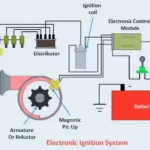
| 14 | Diesel is sprayed by a high-pressure pump injector at the end of the compression stroke to affect combustion. | Battery requires an ignition coil, CB point, distributor and spark plug, etc to perform combustion. |
| 15 | High-pressure pumps and injectors are essential for the fuel system. | AC pump and carburetor are very important for fuel systems. |
| 16 | This engine uses relatively low-quality oil. | High-quality oil is used in this engine. |
| 17 | This engine has more performance. | This engine has low performance. |
| 18 | This engine has a short lifespan. | This engine has a long life. |
| 19 | Relatively low RPM is available. | Maximum RPM is available. |
| 20 | Heavier in weight, for parity. | Lighter in weight, for equal strength. |