What is a Crankshaft?
A crankshaft is a mechanical component in an engine that
converts reciprocating motion into rotational motion. It is typically made of
forged steel or cast iron and consists of one or more cylindrical sections,
known as journals, that are offset from the centerline of the crankshaft.
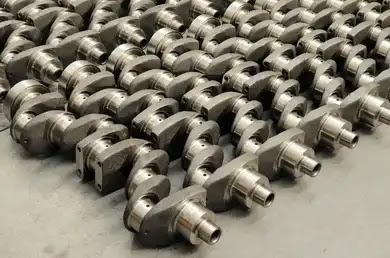
The crankshaft is mounted in the engine block and rotates on
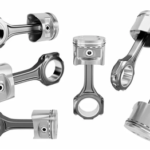
bearings at each end. Pistons are connected to the crankshaft by connecting
rods, and as the pistons move up and down in the cylinders, they transfer
energy to the crankshaft, which converts the reciprocating motion into
rotational motion.
The shape of the crankshaft is designed to ensure that the
pistons move smoothly and efficiently through their cycles, with minimum
vibration and maximum power output. The offset journals on the crankshaft are
carefully positioned to create the correct firing order for the engine, which
ensures that the power strokes of each cylinder are evenly spaced and produce
the maximum power output.
Crankshafts are essential components of internal combustion
engines, including those used in cars, trucks, boats, and generators. They are
designed to withstand high stresses and temperatures and are typically machined
to very precise tolerances to ensure reliable operation and long service life.
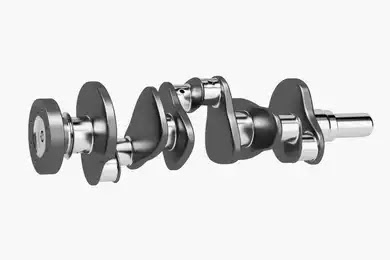
Parts of Crankshaft:
The main parts of a crankshaft include:
- Main
journal: The main journal is the cylindrical section of the crankshaft
that sits in the engine block and rotates on bearings. It connects the
connecting rods to the crankshaft and transfers the energy generated by
the pistons to the crankshaft. - Connecting
rod journal: The connecting rod journal is the cylindrical section of the
crankshaft that connects to the connecting rod, which in turn connects to
the piston. This journal rotates with the motion of the connecting rod as
the piston moves up and down. - Counterweight:
The counterweights are additional weights that are added to the crankshaft
to offset the weight of the pistons and connecting rods. They help to
balance the crankshaft and reduce vibration during operation. - Thrust
bearing: The thrust bearing is a type of bearing that is used to control
axial movement of the crankshaft, ensuring that it remains in position and
does not move forward or backward. - Flange:
The flange is the end of the crankshaft that is used to mount various
engine components, such as the flywheel, timing gear, and pulleys. - Keyway:
The keyway is a small slot cut into the flange of the crankshaft that
allows for the mounting of various engine components with a matching key. - Fillet:
The fillet is the curved area where the main journal and connecting rod
journal meet. It helps to distribute stress and reduce the risk of
cracking or failure.
Overall, the crankshaft is a complex and precisely
engineered component that is essential for the operation of internal combustion
engines. Its various parts work together to ensure smooth and efficient energy
transfer from the pistons to the engine.
Construction of Crankshaft:
Crankshafts are typically made of forged steel or cast iron
and are manufactured using a variety of techniques, depending on the size and
complexity of the component. The construction of a crankshaft involves several
steps, including:
- Design:
The design of a crankshaft takes into account the engine’s specifications,
such as the number of cylinders, displacement, and power output. The
design will determine the size and placement of the main and connecting
rod journals, counterweights, and other features. - Forging
or casting: The crankshaft may be forged or cast depending on the material
and the manufacturing process. Forging involves heating a metal billet and
using a press to shape it into the desired shape, while casting involves
pouring molten metal into a mold. - Machining:
After the forging or casting process, the crankshaft is machined to
precise tolerances. This involves removing excess material and shaping the
various features of the crankshaft, such as the main and connecting rod
journals, counterweights, and flanges. - Heat
treatment: The crankshaft is then heat-treated to improve its strength and
durability. This involves heating the crankshaft to a high temperature and
then quenching it in oil or water to harden the metal. - Grinding
and polishing: Finally, the crankshaft is ground and polished to achieve a
smooth surface finish and precise tolerances. This helps to reduce
friction and improve the overall performance and longevity of the engine.
The construction of a crankshaft is a complex process that
requires careful attention to detail and precision machining techniques. A
well-made crankshaft is essential for the reliable operation of internal
combustion engines, and its construction plays a critical role in the engine’s
overall performance and efficiency.
Working of the Crankshaft:
The crankshaft is a key component in the engine of a vehicle
that converts the reciprocating motion of the pistons into rotational motion
that can be used to drive the wheels or other components of the vehicle. The
working of the crankshaft involves several steps, including:
- Intake
stroke: During the intake stroke, the piston moves downward, drawing air
and fuel into the cylinder. - Compression
stroke: During the compression stroke, the piston moves upward,
compressing the air and fuel mixture in the cylinder. - Power
stroke: During the power stroke, the air and fuel mixture is ignited by
the spark plug, causing a rapid expansion of gases that forces the piston
downward. As the piston moves downward, it transfers energy to the
connecting rod, which in turn transfers energy to the crankshaft. - Exhaust
stroke: During the exhaust stroke, the piston moves upward, pushing the
exhaust gases out of the cylinder.
As the piston moves up and down in the cylinder, the
connecting rod rotates around the connecting rod journal on the crankshaft,
which is offset from the centerline of the crankshaft. The rotation of the
connecting rod causes the crankshaft to rotate, and the offset journals on the
crankshaft convert the reciprocating motion of the pistons into rotational
motion.
The counterweights on the crankshaft help to balance the
weight of the pistons and connecting rods and reduce vibration during
operation. The thrust bearing helps to control axial movement of the
crankshaft, ensuring that it remains in position and does not move forward or
backward.
Overall, the working of the crankshaft is critical to the
operation of an internal combustion engine, and its precise design and
construction play a key role in the engine’s overall performance and
efficiency.
Types of Crankshaft:
There are several types of crankshafts, each with its own
unique design and application. Some common types of crankshafts include:
- Single-plane
crankshaft: This is the simplest type of crankshaft, with all the
connecting rod journals on the same plane. It is commonly used in inline
engines with four or six cylinders. - Cross-plane
crankshaft: This type of crankshaft has connecting rod journals that are
offset 90 degrees from each other, creating a cross pattern. It is
commonly used in V8 engines and provides better balance and smoother
operation. - Flat-plane
crankshaft: This type of crankshaft has connecting rod journals that are
opposite each other, creating a flat plane. It is commonly used in
high-performance engines, particularly those designed for racing. - Stroker
crankshaft: This type of crankshaft has a longer stroke than a standard
crankshaft, which increases the displacement of the engine and can provide
more power. - Billet
crankshaft: This type of crankshaft is machined from a single piece of
billet steel, rather than being forged or cast. It is often used in
high-performance engines and racing applications because it is stronger
and more durable than other types of crankshafts.
The choice of crankshaft depends on the specific application
and requirements of the engine. Factors such as the number of cylinders, the
engine’s power output, and the intended use of the vehicle or equipment will
all influence the choice of crankshaft design.
Advantages and Disadvantages of Crankshaft:
Advantages of Crankshaft:
- Increased
Engine Performance: A well-designed and properly functioning crankshaft
can increase the performance of an engine by providing smooth and
efficient power transfer. - Durability:
Crankshafts are typically made from strong and durable materials that can
withstand the stresses and forces of engine operation. - Precision:
Modern manufacturing techniques allow for crankshafts to be machined to
very precise tolerances, which improves their performance and longevity. - Versatility:
Crankshafts can be designed to work with a wide range of engines, from
small four-cylinder engines to large V8 engines.
Disadvantages of Crankshaft:
- Complex
Design: Crankshafts are complex and precise components that require
careful design and manufacturing. This complexity can make them expensive
to produce and difficult to repair. - High
Stresses: Crankshafts are subject to high stresses and forces during
engine operation, which can lead to fatigue and failure if not designed
and manufactured correctly. - Maintenance:
Crankshafts require regular maintenance to ensure proper function and
prevent damage to other engine components. - Cost:
High-performance crankshafts made from exotic materials can be expensive,
which can add to the overall cost of an engine build or rebuild.
Types of failure in Crankshaft:
Crankshafts are subject to a variety of stresses and forces
during engine operation, and as a result, they can experience several types of
failures. Some common types of failure in crankshafts include:
- Fatigue
failure: This is the most common type of failure in crankshafts and occurs
when the metal is subjected to repeated stresses over time, causing it to
crack and eventually fail. - Overload
failure: This type of failure occurs when the crankshaft is subjected to a
sudden, excessive load that exceeds its strength or design limits, causing
it to fracture or break. - Wear
failure: This type of failure occurs when the crankshaft’s bearings or
journals become worn due to poor lubrication or excessive use, causing the
metal to erode and eventually fail. - Corrosion
failure: This type of failure occurs when the crankshaft is exposed to
moisture or corrosive substances, causing the metal to corrode and weaken
over time. - Manufacturing
defect failure: This type of failure occurs when the crankshaft is
improperly manufactured or designed, leading to defects in the metal or
incorrect dimensions that can cause it to fail prematurely.
The type of failure that occurs in a crankshaft will depend
on a variety of factors, including the type of engine, the materials used, the
operating conditions, and the quality of the manufacturing and maintenance
processes. Regular maintenance and inspection can help to prevent or detect
these failures before they cause significant damage to the engine.
Application of Crankshaft
Crankshafts are widely used in internal combustion engines,
which are used in a variety of applications including:
- Automotive
engines: Crankshafts are used in gasoline and diesel engines for cars,
trucks, buses, and other vehicles. - Marine
engines: Crankshafts are used in marine engines for boats, ships, and
other watercraft. - Industrial
engines: Crankshafts are used in stationary engines for power generation,
construction equipment, and other industrial applications. - Aircraft
engines: Crankshafts are used in aircraft engines for airplanes and
helicopters. - Small
engines: Crankshafts are used in small engines for lawn mowers, chainsaws,
and other small equipment.
In addition to their use in internal combustion engines,
crankshafts are also used in other applications where rotational motion is
required, such as in pumps, compressors, and other machinery. Crankshafts are
also used in some types of electric motors, where they are used to convert the
reciprocating motion of a piston or plunger into rotational motion. Overall,
crankshafts are a critical component in many types of machinery and play a
crucial role in converting reciprocating motion into useful rotational motion.
Difference between Crankshaft and Camshaft
Crankshaft and camshaft are two important components of an
internal combustion engine. They both play crucial roles in the operation of
the engine, but they have some key differences.
- Function:
The main function of the crankshaft is to convert the reciprocating motion
of the pistons into rotational motion, which is used to turn the engine’s
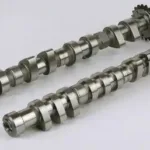
drive shaft. The camshaft, on the other hand, is responsible for
controlling the opening and closing of the engine’s valves, which allows
the air-fuel mixture to enter the combustion chamber and the exhaust gases
to exit. - Shape:
The crankshaft is typically a long, cylindrical shaft with several offset
journals, whereas the camshaft is a shorter, more irregularly shaped shaft
with a series of lobes or cams. - Location:
The crankshaft is located at the bottom of the engine, where it connects
to the pistons and the drive shaft, whereas the camshaft is usually
located in the cylinder head, where it operates the engine’s valves. - Timing:
The crankshaft rotates continuously during engine operation, while the
camshaft rotates only once for every two rotations of the crankshaft. This
timing difference is crucial for the proper operation of the engine. - Material:
Both crankshafts and camshafts are typically made from high-strength
materials, such as forged or cast steel, but they may have different
coatings or surface treatments depending on their specific functions and
operating conditions.
In summary, while both crankshaft and camshaft are important
components of an internal combustion engine, they have different shapes,
locations, functions, and timing. The crankshaft is responsible for converting
reciprocating motion to rotational motion, while the camshaft controls the
engine’s valves.
Crankshaft Function
The crankshaft is a key component of an internal combustion
engine and its main function is to convert the reciprocating motion of the
pistons into rotational motion. The pistons move up and down in the cylinders,
driven by the force of the combustion of the air-fuel mixture. This
reciprocating motion is transferred to the crankshaft through the connecting
rods, which are attached to the pistons at one end and to the crankshaft at the
other end.
The crankshaft has several offset journals, where the
connecting rods are attached, and the rotation of the crankshaft causes the
connecting rods to move up and down in a circular motion, which in turn rotates
the engine’s drive shaft. The rotation of the drive shaft is used to power the
vehicle’s wheels or other machinery.
In addition to its main function of converting reciprocating
motion into rotational motion, the crankshaft also helps to balance the engine
and reduce vibration by providing a counterweight to the movement of the
pistons. It is also designed to withstand high levels of stress and torque, and
must be precisely machined and balanced to ensure smooth operation and long
service life.
Overall, the crankshaft is a critical component of an internal
combustion engine and is essential to the proper operation and performance of
the engine.
Crankshaft Materials:
Crankshafts are typically made from materials that are
strong, durable, and can withstand high stresses and temperatures. Here are
some of the most common materials used to make crankshafts:
- Cast
Iron: Cast iron is a popular material for crankshafts because of its high
strength and durability. It can withstand high temperatures and has good
wear resistance, making it ideal for use in heavy-duty engines. - Steel:
Steel is another popular material for crankshafts, as it has excellent
strength, durability, and fatigue resistance. It can also be machined to
precise tolerances, allowing for high levels of accuracy and performance. - Forged
Steel: Forged steel is a type of steel that is heated and then hammered
into shape, resulting in a material that is even stronger and more durable
than regular steel. Forged steel crankshafts are commonly used in
high-performance engines. - Billet
Steel: Billet steel is a type of steel that is machined from a single
block of metal, resulting in a highly precise and uniform material. Billet
steel crankshafts are commonly used in racing engines, where accuracy and
performance are critical. - Aluminum:
While less common than cast iron or steel, aluminum crankshafts are
sometimes used in lightweight, high-performance engines. Aluminum is
lightweight and has good heat dissipation properties, but it is less
durable than cast iron or steel and may not be suitable for heavy-duty
applications.
Overall, the choice of material for a crankshaft depends on
factors such as the engine’s power, torque, and operating conditions, as well
as the desired level of durability, performance, and weight.
Crankshaft Heat Treating:
Heat treating is an important process in the manufacturing
of crankshafts, as it helps to increase their strength, durability, and wear
resistance. Here are the main steps involved in heat treating a crankshaft:
- Preheating:
The crankshaft is first heated to a uniform temperature, typically between
800 and 900 degrees Celsius, to relieve any residual stresses in the
metal. - Quenching:
The crankshaft is then rapidly cooled, usually by immersion in a quenching
oil or water bath. This sudden cooling causes the metal to harden and increases
its strength and wear resistance. - Tempering:
The crankshaft is then heated again, this time to a lower temperature,
typically between 200 and 400 degrees Celsius, to reduce the hardness and
brittleness caused by the quenching process. This step helps to improve
the crankshaft’s toughness and resistance to cracking. - Shot
peening: In some cases, the surface of the crankshaft may be shot-peened
after heat treating to further increase its strength and durability. Shot
peening involves bombarding the metal surface with small, high-velocity
metal or ceramic particles, which helps to smooth out any surface
imperfections and create a layer of compressive stress that can help to
prevent fatigue and cracking.
Overall, heat treating is an important process in the
manufacturing of crankshafts, as it helps to improve their strength,
durability, and wear resistance. The specific heat treatment process used may
vary depending on the type of metal used to make the crankshaft, as well as the
specific performance requirements of the engine in which it will be used.
Crankshaft Manufacturing Processes:
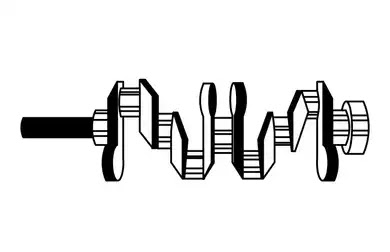
Crankshafts are critical components of internal combustion
engines, and they are typically made using a combination of forging, machining,
and heat treating processes. Here are the main steps involved in manufacturing
a crankshaft:
- Forging:
The first step in manufacturing a crankshaft is usually forging. This
involves heating a billet of metal, typically steel, to a high temperature
and then using a forging press to shape the metal into a rough
approximation of the final crankshaft shape. Forging helps to align the
grain structure of the metal, improving its strength and durability. - Rough
machining: After forging, the crankshaft is typically rough machined to
remove any excess material and bring it closer to its final shape. This
may involve using a lathe, milling machine, or other machining tools to
cut and shape the metal. - Heat
treating: The next step is heat treating, as described in the previous
answer. Heat treating helps to increase the strength, durability, and wear
resistance of the crankshaft. - Finish
machining: After heat treating, the crankshaft is typically machined again
to bring it to its final size and shape. This may involve using grinding,
drilling, and other precision machining techniques to achieve the required
tolerances. - Surface
treatment: Depending on the specific application, the crankshaft may also
undergo additional surface treatments, such as nitriding or chrome
plating, to further increase its wear resistance and durability. - Quality
control: Finally, the crankshaft undergoes rigorous quality control
testing to ensure that it meets the required specifications and
performance standards. This may involve using non-destructive testing
methods, such as magnetic particle inspection, to detect any cracks or
defects in the metal.
Overall, the manufacturing of a crankshaft is a complex and
precise process that involves multiple stages of forging, machining, heat
treating, and quality control. The specific process used may vary depending on
the type of engine and performance requirements, but the end goal is always to
produce a strong, durable, and reliable component that can withstand the rigors
of engine operation.
Read More: Camshaft: Definition, Parts, Working, Types, Material, Advantages, Application