A reaction turbine is a type of turbine that converts the
energy of a fluid into rotational energy by extracting the kinetic energy of
the fluid through a series of rotating blades. Unlike impulse turbines, which
operate on the principle of the high-velocity impact of a fluid on a set of
stationary blades, reaction turbines operate on the principle of the reaction
force generated by the fluid as it passes over a set of moving blades.
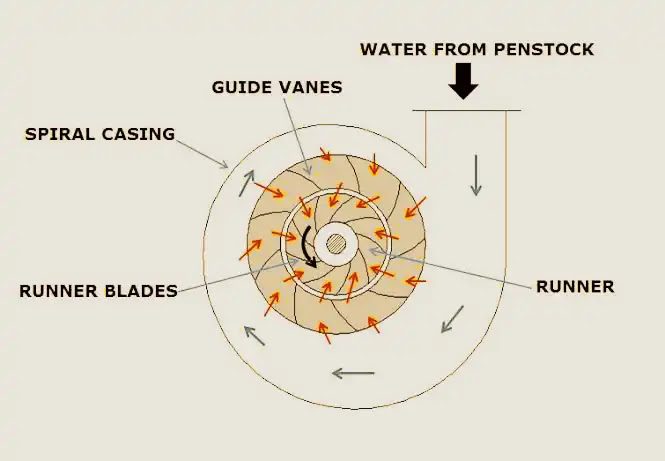
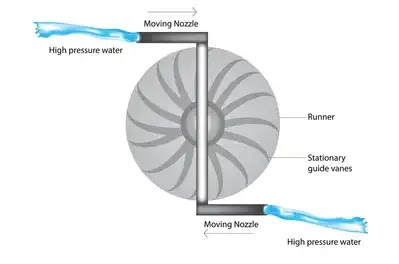
In a reaction turbine, the fluid enters the turbine through
a series of fixed guide vanes, which direct the fluid onto a set of moving
blades on the turbine rotor. As the fluid passes over the blades, it creates a
force that causes the rotor to rotate. The blades are designed in such a way
that they create a pressure difference across them, which causes the fluid to
accelerate as it passes over them, thereby increasing the kinetic energy
extracted from the fluid.
Reaction turbines are commonly used in hydroelectric power
generation, where the energy of falling water is used to rotate the turbine
rotor and generate electricity. They are also used in other power generation
applications, such as steam turbine power plants, where the energy of
high-pressure steam is used to drive the turbine rotor.
Overall, reaction turbines are known for their high
efficiency and durability, and are widely used in a variety of power generation
applications where a large amount of energy is needed to generate electricity.
Parts of Reaction Turbine
The major parts of a reaction turbine include:
Casing:
The casing is the outer shell of the turbine that contains the rotor and
other internal components. It is designed to withstand the high pressures
and temperatures generated by the turbine.
Rotor:
The rotor is the rotating part of the turbine that contains the blades. It
is connected to the generator shaft and rotates at high speeds to generate
mechanical energy.
Blades:
The blades are the curved, airfoil-shaped components that extract energy
from the fluid and convert it into rotational energy. They are mounted on
the rotor and are designed to create a pressure difference across them to
accelerate the fluid and increase the kinetic energy extracted from it.
Shaft:
The shaft is the component that connects the rotor to the generator and
transfers the mechanical energy generated by the turbine to the generator
to produce electricity.
Bearings:
The bearings support the shaft and allow it to rotate freely. They are
designed to withstand the high speeds and loads generated by the turbine.
Inlet
guide vanes: The inlet guide vanes are fixed vanes located at the entrance
of the turbine. They direct the fluid onto the blades at the correct angle
to maximize energy extraction.
Draft
tube: The draft tube is a conical-shaped tube located at the exit of the
turbine. It helps to reduce the fluid velocity and recover some of the
kinetic energy that would otherwise be lost as the fluid exits the
turbine.
These are the major parts of a reaction turbine, although
there may be other components depending on the specific design and application
of the turbine.
Working of Reaction Turbine
The working of a reaction turbine can be explained as
follows:
The
fluid (usually water) enters the turbine casing through an inlet and flows
through the fixed guide vanes that direct it onto the moving blades of the
rotor.
As the
fluid passes over the blades, it exerts a force on them, causing the rotor
to rotate. The blades are designed such that they create a pressure
difference across them, which causes the fluid to accelerate and increase
the kinetic energy extracted from it.
The
fluid then exits the turbine through the draft tube, which helps to reduce
the fluid velocity and recover some of the kinetic energy that would otherwise
be lost as the fluid exits the turbine.
The
rotation of the rotor is transmitted to the generator shaft, which
generates electricity through electromagnetic induction.
The
electricity generated is then transmitted to the electrical grid for
distribution to consumers.
The efficiency of a reaction turbine depends on various
factors, including the fluid flow rate, the design of the turbine blades, the
number of stages, and the size of the turbine. Reaction turbines are known for
their high efficiency and durability, and are widely used in a variety of power
generation applications, such as hydroelectric power plants and steam turbine
power plants.
Types of Reaction Turbine
There are several types of reaction turbines, including:
Francis
turbine: This is the most common type of reaction turbine, and is suitable
for medium to high head applications. It has a mixed flow design, with
both radial and axial flow of the fluid. The fluid enters the turbine
through a spiral casing, and flows over fixed guide vanes and onto the
rotating blades of the rotor.
Kaplan
turbine: This is a propeller-type reaction turbine that is suitable for
low head applications. It has adjustable blades that can be adjusted to
optimize efficiency over a wide range of operating conditions.
Propeller
turbine: This is a simple type of reaction turbine that has a fixed pitch
propeller as the rotor. It is suitable for low head applications, and has
a high flow rate and low efficiency.
Bulb
turbine: This is a compact type of reaction turbine that is suitable for
low head applications. It has a horizontal axis and is mounted directly on
the generator, which makes it easy to install and maintain.
Tubular
turbine: This is a type of reaction turbine that has a vertical axis and
is suitable for low head applications. It has a compact design and is
often used in small hydroelectric power plants.
Each type of reaction turbine has its own advantages and
disadvantages, and is suitable for different applications depending on the
head, flow rate, and other operating conditions of the fluid.
Advantages and Disadvantages of Reaction Turbine
Advantages of Reaction Turbine:
High
efficiency: Reaction turbines are known for their high efficiency,
especially in comparison to other types of turbines.
Wide
range of applications: Reaction turbines are suitable for a wide range of
applications, from low head to high head and from small to large scale.
Low
maintenance: Reaction turbines have a simple design and are relatively
easy to maintain, which makes them cost-effective in the long run.
Reliable:
Reaction turbines have a proven track record of reliability, which is
important for applications where downtime can be costly.
Disadvantages of Reaction Turbine:
Complex
design: The design of reaction turbines is more complex than that of
impulse turbines, which can make them more difficult to manufacture and
repair.
High
cost: Reaction turbines are often more expensive than other types of
turbines due to their complex design and high efficiency.
Limited
control: The performance of a reaction turbine is largely dependent on the
flow rate and pressure of the fluid, which can be difficult to control in
some applications.
Vulnerable
to damage: The blades of reaction turbines can be damaged by debris in the
fluid, which can result in costly repairs or downtime.
Overall, the advantages of reaction turbines generally
outweigh the disadvantages, especially in applications where high efficiency
and reliability are important.
Applications of Reaction Turbine
Reaction turbines are commonly used in hydroelectric power
plants to generate electricity from the flow of water. They are also used in
other industries, such as:
Pumps
and compressors: Reaction turbines are used in pumps and compressors to
convert the energy of the fluid into mechanical energy.
Marine
propulsion: Reaction turbines are used in marine propulsion systems, where
they convert the energy of the fluid into rotational energy to drive the
propeller.
Gas
turbines: Reaction turbines are used in gas turbines to convert the energy
of the expanding gas into mechanical energy.
Wind
turbines: Some types of wind turbines use reaction turbines to convert the
energy of the wind into mechanical energy.
Paper
and pulp industry: Reaction turbines are used in the paper and pulp
industry to power the machines that process wood into paper and other
products.
The specific application of a reaction turbine depends on
the type of turbine, the head and flow rate of the fluid, and other operating
conditions.
Difference Between Reaction Turbine and Impulse Turbine
The main difference between a reaction turbine and an
impulse turbine is the way they convert the energy of the fluid into mechanical
energy.
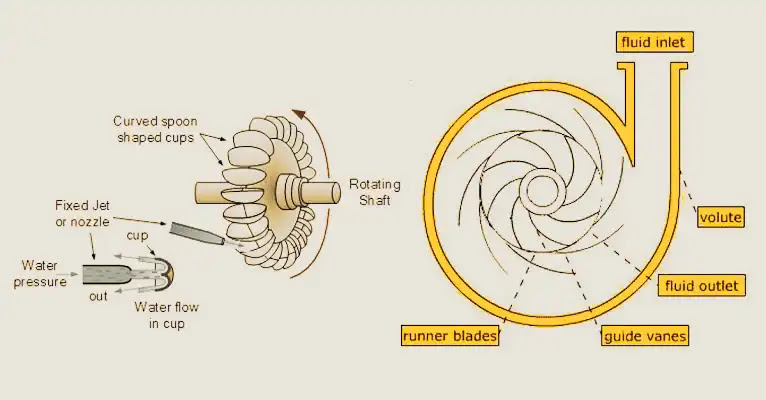
In an impulse turbine, the fluid is directed onto the blades
of the rotor in a series of high velocity jets, which impact the blades and
cause them to rotate. The rotor is designed to extract energy from the fluid in
the form of kinetic energy, and as a result, the pressure of the fluid
decreases as it passes through the turbine.
In a reaction turbine, the fluid is directed onto the blades
of the rotor in a way that allows the fluid to flow over the blades and cause
them to rotate. The rotor is designed to extract energy from the fluid in the
form of both kinetic energy and pressure energy, and as a result, the pressure
of the fluid remains relatively constant as it passes through the turbine.
Another key difference between the two types of turbines is
their suitability for different applications. Impulse turbines are typically
used in high head applications, where the fluid has a high velocity and low
flow rate, while reaction turbines are typically used in low head applications,
where the fluid has a low velocity and high flow rate.
In summary, impulse turbines extract energy from the fluid
in the form of kinetic energy, while reaction turbines extract energy from the
fluid in the form of both kinetic energy and pressure energy. The choice between
the two types of turbines depends on the specific application and the
characteristics of the fluid being used.
Reaction Turbine Example
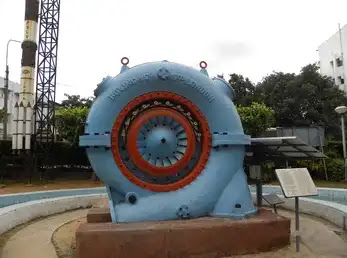
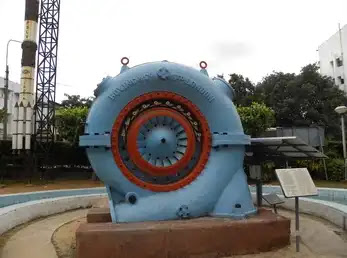
A Francis turbine is a common example of a reaction turbine.
It is widely used in hydropower plants for generating electricity from water.
The turbine was invented by American engineer James B. Francis in the
mid-1800s.
The Francis turbine has a series of curved blades that are
fixed to a rotating shaft. Water enters the turbine through the stationary
guide vanes and flows through the runner blades. The shape of the blades causes
the water to change direction and accelerate as it passes through the turbine.
The pressure drop across the turbine causes the turbine to rotate, which drives
a generator to produce electricity.
Francis turbines are known for their efficiency and
flexibility, as they can operate over a wide range of flow rates and water head
conditions. They are used in a variety of applications, including hydroelectric
power plants, irrigation systems, and water treatment facilities.