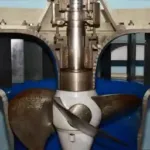
An impulse turbine is a type of steam turbine that uses the
force of high-pressure steam to generate rotational energy. The turbine is
designed with a series of fixed nozzles or blades, known as guide vanes, that
direct the flow of high-pressure steam onto a set of moving blades, called
impulse blades, mounted on a rotor. As the steam strikes the impulse blades, it
imparts a force that causes the rotor to rotate, generating mechanical energy.
The basic operating principle of an impulse turbine is based
on the concept of impulse and reaction. In an impulse turbine, the steam flows
through a set of nozzles or guide vanes, which direct the steam onto a set of
moving blades. The force of the high-pressure steam hitting the impulse blades
generates an impulse force, which causes the rotor to rotate. The rotor, in
turn, drives a generator or other mechanical device to generate electricity or
perform work.
Impulse turbines are typically used in applications where
high-speed rotation is required, such as in small-scale power generation, steam
locomotives, and hydroelectric power plants. They are known for their
simplicity and reliability and are often used in applications where maintenance
and repair are difficult or expensive. However, they are generally less efficient
than reaction turbines, which use a more complex design to extract more energy
from the steam.
Types of Impulse Turbine:
There are two main types of impulse turbine:
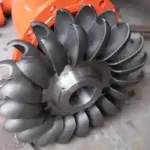
Pelton
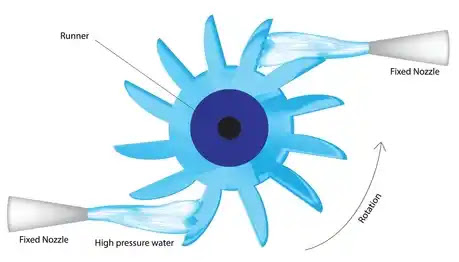
turbine: A Pelton turbine is a type of impulse turbine that is used for
high head applications, typically in hydroelectric power plants. It uses
one or more nozzles to direct a high-pressure jet of water onto a set of
spoon-shaped buckets mounted on a wheel. The force of the water hitting
the buckets causes the wheel to rotate, generating mechanical energy.
Turgo
turbine: A Turgo turbine is a type of impulse turbine that is used for
medium head applications. It uses one or more nozzles to direct a
high-pressure jet of water onto a set of double-curved blades mounted on a
wheel. The force of the water hitting the blades causes the wheel to
rotate, generating mechanical energy.
Other types of impulse turbines include the Crossflow
turbine, which is used for low head applications and has a vertical axis, and
the Banki-Michell turbine, which is used for medium head applications and has a
diagonal axis. However, Pelton and Turgo turbines are the most common types of
impulse turbines in use today.
Components of an Impulse Turbine:
The main components of an impulse turbine include:
Nozzles:
Nozzles are small openings in the turbine casing that direct high-pressure
steam or water onto the turbine blades. They are designed to accelerate
the steam or water to high velocities, which helps to maximize the kinetic
energy of the fluid.
Guide
vanes: Guide vanes are stationary blades that are positioned around the
turbine rotor to direct the flow of steam or water onto the turbine
blades. They are designed to control the direction and velocity of the
fluid entering the turbine, which helps to maximize the efficiency of the
turbine.
Impulse
blades: Impulse blades are a set of moving blades that are mounted on the
turbine rotor. They are designed to receive the high-velocity steam or
water from the nozzles and convert the kinetic energy of the fluid into rotational
energy, which drives the turbine rotor.
Rotor:
The rotor is the rotating component of the turbine that is driven by the
impulse blades. It is typically made of steel or other high-strength
materials and is designed to withstand the high stresses and temperatures
generated during operation.
Shaft:
The shaft is a rigid component that connects the rotor to the external
load, such as a generator or mechanical device. It is designed to transmit
the rotational energy generated by the turbine to the load with minimal
loss.
Casing:
The casing is a large, cylindrical structure that encloses the turbine
components and provides a sealed environment for the high-pressure steam
or water. It is typically made of steel or other high-strength materials
and is designed to withstand the high pressures and temperatures generated
during operation.
Other components of an impulse turbine may include bearings,
seals, and cooling systems, which are necessary to ensure reliable and
efficient operation of the turbine.
Working Principle of Impulse Turbine:
The working principle of an impulse turbine is based on the
principle of impulse and reaction. When high-pressure steam or water is
directed onto a set of impulse blades, it imparts a force on the blades,
causing the rotor to rotate.
The operation of an impulse turbine can be described in the
following steps:
High-pressure
steam or water is directed through a nozzle, which accelerates the fluid
to a high velocity.
The
high-velocity fluid is directed onto a set of guide vanes, which control
the direction and velocity of the fluid entering the turbine.
The
fluid then enters a set of impulse blades, which are mounted on the
turbine rotor. The force of the high-velocity fluid hitting the blades
generates an impulse force, causing the rotor to rotate.
As the
rotor rotates, it drives a generator or other mechanical device,
generating mechanical energy.
The
low-pressure fluid exits the turbine and is directed to a condenser or
other device to recover the heat energy.
The efficiency of an impulse turbine depends on a number of
factors, including the design of the nozzle, the size and shape of the blades,
and the speed and temperature of the fluid. The design of an impulse turbine is
typically optimized for a specific range of operating conditions, such as steam
pressure, temperature, and flow rate, to maximize its efficiency and
performance.
Advantages and Disadvantages of Impulse Turbine
Advantages of Impulse Turbine:
High
Efficiency: Impulse turbines are known for their high efficiency,
particularly in high head applications, due to their ability to convert
the kinetic energy of the fluid into rotational energy with minimal
losses.
Simple
Design: Impulse turbines have a relatively simple design compared to other
types of turbines, which makes them easier to manufacture, operate, and
maintain.
Durable:
Impulse turbines are generally very durable and can withstand high
temperatures, pressures, and other extreme operating conditions.
Easy
to Control: The speed and power output of an impulse turbine can be easily
controlled by adjusting the flow rate of the fluid and the size of the
nozzle.
Suitable
for High Head Applications: Impulse turbines are particularly well-suited
for high head applications, where the fluid has a high velocity and can
generate a significant amount of kinetic energy.
Disadvantages of Impulse Turbine:
Limited
Applications: Impulse turbines are generally not suitable for low head
applications, as the fluid velocity is not high enough to generate
significant amounts of kinetic energy.
Limited
Power Output: Impulse turbines are generally not suitable for large-scale
power generation applications, as their power output is limited by their
size and design.
High
Maintenance Costs: Impulse turbines require regular maintenance to ensure
reliable and efficient operation, which can be costly and time-consuming.
Noise
and Vibration: Impulse turbines can generate significant amounts of noise
and vibration during operation, which can be a concern in some
applications.
Limited
Control Range: While impulse turbines are easy to control, their control
range is limited by the size and design of the nozzle, which can restrict
their flexibility in certain applications.
Impulse Turbine Application:
Impulse turbines are commonly used in applications where a
high head of fluid is available, such as hydroelectric power generation and
certain industrial processes. Some specific applications of impulse turbines
include:
Hydroelectric
Power Generation: Impulse turbines are commonly used in hydroelectric
power plants, where water is directed from a high head dam through a
turbine to generate electricity.
Gas
Turbine Engines: Gas turbines typically use an impulse turbine to drive
the compressor that compresses the air before it enters the combustion
chamber.
Steam
Turbines: Impulse turbines are also used in steam turbine power plants,
where high-pressure steam is directed onto the blades of the turbine to
generate electricity.
Jet
Engines: Jet engines use an impulse turbine to drive the fan that draws
air into the engine.
Industrial
Processes: Impulse turbines can also be used in certain industrial
processes, such as in the pulp and paper industry, where steam is used to
power various equipment and processes.
Overall, the high efficiency and durability of impulse
turbines make them well-suited for a wide range of applications where a high
head of fluid is available, and where a simple, reliable, and efficient power
source is required.
Difference Between Impulse Turbine and Reaction Turbine
The main difference between impulse turbine and reaction
turbine is in the way they extract energy from the fluid flowing through them.
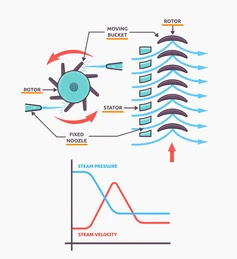
In an impulse turbine, the high-pressure fluid is directed
onto a set of stationary nozzles, which convert the pressure energy into
kinetic energy, creating a high-velocity jet of fluid that impacts a set of
moving blades mounted on the turbine rotor. The impact of the fluid on the
blades generates an impulse force, which causes the rotor to rotate. Therefore,
impulse turbines are also called velocity turbines.
In a reaction turbine, the fluid flows through a set of
fixed blades, known as the stator, which converts the pressure energy of the
fluid into kinetic energy, creating a high-velocity jet of fluid that flows
over a set of moving blades mounted on the turbine rotor. The interaction
between the fluid and the blades generates a reaction force, which causes the
rotor to rotate. Therefore, reaction turbines are also called pressure
turbines.
Other differences between impulse and reaction turbines
include:
Design:
The design of an impulse turbine is generally simpler than that of a
reaction turbine, as there are fewer blades and other components.
Efficiency:
Impulse turbines are generally more efficient than reaction turbines at
high heads of fluid, whereas reaction turbines are more efficient at low
heads of fluid.
Applications:
Impulse turbines are generally used in applications where a high head of
fluid is available, such as hydroelectric power generation, while reaction
turbines are used in applications where a low head of fluid is available,
such as wind turbines.
Power
Output: Impulse turbines generally have a lower power output than reaction
turbines for a given size, due to their smaller number of blades and other
components.
In summary, impulse and reaction turbines differ in their
design, efficiency, applications, and power output, and are used in different
types of power generation systems depending on the availability and head of the
fluid being used.
Impulse Turbine Example
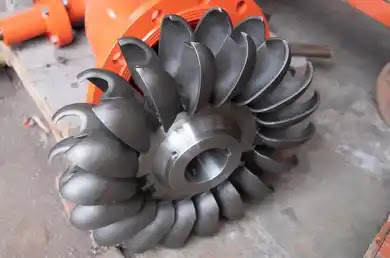
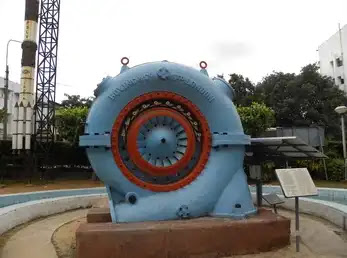
One example of an impulse turbine is the Pelton turbine,
which is commonly used in hydroelectric power generation. The Pelton turbine
consists of a set of stationary nozzles that direct a high-pressure jet of
water onto a set of double-cupped buckets mounted on a rotor. The impact of the
jet on the buckets generates an impulse force that causes the rotor to rotate,
and the rotation is transmitted to a generator to produce electricity.
The Pelton turbine is particularly well-suited for use in
high-head hydroelectric power plants, where a large amount of pressure energy
is available. The design of the Pelton turbine allows it to efficiently convert
the pressure energy of the water into mechanical energy, which can then be used
to generate electricity.
Other examples of impulse turbines include the Turgo turbine
and the Cross-flow turbine, which are also used in hydroelectric power
generation and other applications where a high-head of fluid is available.
আমি Md Shamim Hossain, TonBangla-এর প্রতিষ্ঠাতা। প্রযুক্তি, কম্পিউটার, প্রোগ্রামিং, প্রকৌশল ও শিক্ষামূলক বিষয় নিয়ে সহজ, তথ্যবহুল বাংলা কনটেন্ট তৈরি করি।