What Is Resistor?
A resistor is an electronic component designed to resist the
flow of electrical current. It is commonly used in electronic circuits to
control or limit the amount of current flowing through a circuit. The
resistance of a resistor is measured in ohms, and it is typically denoted by a
color-coded band or stripe on the resistor. Resistors come in various shapes
and sizes, and they can be made from a variety of materials, such as carbon,
metal, or wire-wound materials. Some common uses of resistors include voltage
division, current limiting, and signal attenuation.

Types of Resistors
There are several types of resistors, each with their own
characteristics and applications. Here are some of the most common types of
resistors:
- Carbon
composition resistor: This type of resistor is made of a mixture of carbon
and a binder material. It is relatively inexpensive and has a high
tolerance for temperature changes. However, it is less precise and can
produce more noise than other types. - Film
resistor: This type of resistor is made of a thin film of metal on a
ceramic substrate. It is more precise than carbon composition resistors
and has lower noise levels. It is also less affected by temperature
changes. - Wire wound
resistor: This type of resistor is made of a length of wire wound around a
ceramic or metal core. It has a high power rating and can handle high
temperatures. It is commonly used in power supplies and high-frequency
circuits. - Thick
film resistor: This type of resistor is made of a thick layer of
conductive material deposited on a ceramic substrate. It is a low-cost
option and can be used for high-frequency circuits. However, it has a
lower accuracy than other types of resistors. - Variable
resistor: Also known as a potentiometer, this type of resistor has a
variable resistance that can be adjusted using a knob or dial. It is
commonly used to control volume or other parameters in electronic
circuits. - Thermistor:
This type of resistor is made of a material whose resistance changes with
temperature. It can be either positive temperature coefficient (PTC) or
negative temperature coefficient (NTC) depending on the direction of
resistance change with temperature. Thermistors are commonly used in
temperature sensing applications. - Light-dependent
resistor (LDR): Also known as a photoresistor, this type of resistor
changes its resistance in response to the intensity of light falling on
it. It is commonly used in light sensing and control applications. - Metal
film resistor: This type of resistor is made of a thin layer of metal
deposited on a ceramic substrate. It has a high accuracy and low noise
levels, making it ideal for use in precision circuits. - Surface
mount resistor: This type of resistor is designed to be mounted directly
onto the surface of a printed circuit board (PCB). It is small in size and
can be used in high-density electronic circuits. - Network
resistor: This type of resistor contains multiple resistors connected in a
specific pattern. It is commonly used in circuits that require multiple
resistors of different values.
These are just a few examples of the many types of resistors
available, each with their own specific applications and characteristics.
Working principle of Resistor
The working principle of a resistor is based on the physical
property of a material to resist the flow of electric current through it. A
resistor is a passive electronic component that is designed to provide a
specific level of electrical resistance to the flow of current passing through
it.

When an electric current flows through a resistor, it
encounters resistance due to the collisions between the electrons and the atoms
of the material. This results in the conversion of electrical energy into heat
energy, which is dissipated into the surrounding environment.
The resistance of a resistor is measured in ohms, which is
the unit of electrical resistance. The resistance of a resistor is determined
by its physical dimensions, the material used, and its temperature.
Resistors are used in electronic circuits for a variety of
purposes, such as to limit the flow of current, to reduce voltage, to control
gain in amplifiers, and to provide a specific level of impedance to a circuit.
By controlling the level of resistance, resistors help to regulate the flow of
current and voltage in an electronic circuit, thus ensuring proper operation of
the circuit.
Applications of Resistor
Resistors are widely used in electronic circuits for a
variety of applications. Here are some of the most common applications of
resistors:
- Voltage
Divider: Resistors are commonly used to divide voltage in a circuit. By
connecting two resistors in series, the voltage can be divided between
them according to their resistance values. - Current
Limiting: Resistors are used to limit the flow of current in a circuit.
This is important to prevent damage to electronic components and ensure
the proper operation of the circuit. - LED
Current Limiting: Resistors are commonly used in series with an LED to
limit the current flowing through the LED. This prevents the LED from
burning out due to excessive current. - Signal
Conditioning: Resistors are used in signal conditioning circuits to modify
the characteristics of a signal. For example, a resistor can be used to
adjust the gain of an amplifier. - Timing
Circuits: Resistors and capacitors are commonly used in timing circuits,
such as those used in oscillators and timers. - Temperature
Sensing: Resistors can be used as temperature sensors. By measuring the
resistance of a resistor, the temperature of the material can be
determined. - Power
Dissipation: Resistors can be used to dissipate power in a circuit. This
is important to prevent overheating and damage to electronic components.
Overall, resistors are an essential component in electronic
circuits, providing control and regulation of electrical current and voltage to
ensure proper operation of the circuit.
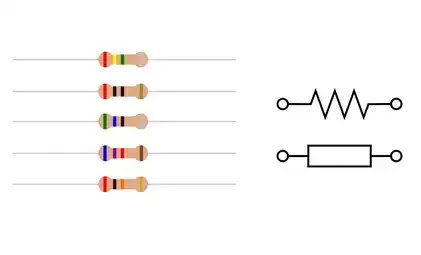
Resistor Symbol

Advantages and Disadvantages of Resistor
Advantages of Resistors:
- Precise
Control: Resistors offer precise control over the flow of current and
voltage in a circuit, allowing for accurate measurement and regulation of
the circuit. - Reliability:
Resistors are simple and reliable electronic components that can withstand
a wide range of temperatures, making them ideal for use in a variety of
applications. - Cost-effective:
Resistors are relatively inexpensive and readily available, making them a
cost-effective solution for use in electronic circuits. - Low
Power Consumption: Resistors consume very little power, making them ideal
for use in battery-powered electronic devices.
Disadvantages of Resistors:
- Power
Dissipation: Resistors dissipate power in the form of heat, which can be a
disadvantage in high-power applications. Large resistors may need to be
used to avoid overheating. - Non-ideal
Characteristics: Resistors can have non-ideal characteristics, such as
temperature dependency and noise, which can affect the performance of the
circuit. - Limited
Range: Resistors have a limited range of values, which can limit their
usefulness in certain applications. - Large
Size: High-power resistors can be quite large, which can make them
difficult to incorporate into compact electronic devices.
Overall, resistors are essential components in electronic
circuits that offer precise control over the flow of current and voltage, and
are relatively inexpensive and reliable. However, their power dissipation,
non-ideal characteristics, limited range, and large size can be disadvantages
in some applications.
Resistor Color Codes
Resistors are often marked with color-coded bands that
indicate their resistance value and tolerance. The color codes are standardized
to help identify the values of resistors easily. Here is a guide to
understanding resistor color codes:
- The
first two bands indicate the significant digits of the resistance value.
Color codes for significant digits:
- Black:
0 - Brown:
1 - Red:
2 - Orange:
3 - Yellow:
4 - Green:
5 - Blue:
6 - Violet:
7 - Gray:
8 - White:
9 - The
third band indicates the multiplier, which is used to calculate the actual
resistance value by multiplying the significant digits with the multiplier
value.
Color codes for multipliers:
- Black:
x1 - Brown:
x10 - Red:
x100 - Orange:
x1,000 - Yellow:
x10,000 - Green:
x100,000 - Blue:
x1,000,000 - Violet:
x10,000,000 - Gray:
x100,000,000 - White:
x1,000,000,000 - The
fourth band indicates the tolerance of the resistor, which indicates the
range within which the actual resistance value can vary.
Color codes for tolerances:
- Gold:
+/- 5% - Silver:
+/- 10% - None:
+/- 20%
For example, a resistor with the color bands
brown-black-green-gold would have a resistance value of 1.0 ohm (brown = 1,
black = 0, green = x10), with a tolerance of +/- 5% (gold band).
Here is a table of the resistor color codes for easy
reference:
|
Color |
Significant |
Significant |
Multiplier |
Tolerance |
|
Black |
0 |
0 |
x1 |
None |
|
Brown |
1 |
1 |
x10 |
+/- 1% |
|
Red |
2 |
2 |
x100 |
+/- 2% |
|
Orange |
3 |
3 |
x1,000 |
None |
|
Yellow |
4 |
4 |
x10,000 |
None |
|
Green |
5 |
5 |
x100,000 |
+/- |
|
Blue |
6 |
6 |
x1,000,000 |
+/- |
|
Violet |
7 |
7 |
x10,000,000 |
+/- |
|
Gray |
8 |
8 |
x100,000,000 |
+/- |
|
White |
9 |
9 |
x1,000,000,000 |
None |
|
Gold |
– |
– |
x0.1 |
+/- 5% |
|
Silver |
– |
– |
x0.01 |
+/- 10% |
To determine the resistance value of a resistor, simply
identify the color of each band and use the color codes to calculate the
resistance value.
Difference between Resistor and Resistance
A resistor is an electronic component that is used to limit
or regulate the flow of electric current in a circuit. It is made of a material
with a high resistance to the flow of electricity, and it is designed to provide
a specific amount of resistance to the flow of current.
Resistance, on the other hand, is a measure of how much a
material or component resists the flow of electric current. It is measured in
ohms and is the ratio of the voltage applied to a material or component to the
resulting current that flows through it.
In summary, a resistor is a physical component that provides
resistance to the flow of current, while resistance is the measure of how much
a material or component resists the flow of current.