What is Centrifugal Pump?
A centrifugal pump is a type of mechanical device used to
transport fluids by converting rotational kinetic energy into hydrodynamic
energy. The pump consists of an impeller, which is a rotating component that
has curved blades that push the fluid in a circular motion, creating
centrifugal force.

The fluid enters the pump through the center of the
impeller, and as the impeller rotates, the centrifugal force pushes the fluid
towards the outer edges of the impeller, where it is discharged through a
volute casing or diffuser. The pump operates by increasing the velocity and
pressure of the fluid, allowing it to be transported through a system of pipes
or other channels.
Centrifugal pumps are commonly used in a wide range of
applications, including water supply and irrigation systems, chemical
processing, petroleum refining, and HVAC systems. They are generally considered
to be simple and reliable devices, with a relatively low maintenance
requirement, making them a popular choice for many industries.
Parts of Centrifugal Pump
A centrifugal pump consists of several main parts,
including:
- Impeller:
This is a rotating component with curved blades that is responsible for
creating centrifugal force and moving the fluid. - Casing:
The casing is a stationary component that surrounds the impeller and helps
to guide the fluid from the inlet to the outlet. - Shaft:
The shaft connects the impeller to the motor or other driving device and
transmits the rotational force from the motor to the impeller. - Bearings:
The bearings support the shaft and allow it to rotate smoothly. - Mechanical
seal: This is a device that prevents leakage between the pump and the
motor or other driving device. - Inlet
and outlet: The inlet is where the fluid enters the pump, while the outlet
is where the fluid is discharged. - Volute
or diffuser: This is a component that helps to convert the high-velocity
fluid leaving the impeller into high-pressure fluid that can be discharged
through the outlet. - Motor:
This is the driving device that provides the rotational energy needed to
turn the impeller.
There may be additional components or accessories depending
on the specific design and application of the centrifugal pump.
Working Principle of Centrifugal Pump
The working principle of a centrifugal pump is based on the
transfer of rotational energy from a motor or other driving device to the
impeller, which causes the fluid to move in a circular motion. This circular
motion creates centrifugal force that pushes the fluid towards the outer edges
of the impeller, where it is discharged through a volute casing or diffuser.
The operation of a centrifugal pump can be divided into
three main stages:
- Suction
stage: The impeller is rotated by the motor, creating a low-pressure zone
at the center of the impeller. This low-pressure zone causes the fluid to
enter the pump through the inlet and fill the space between the impeller
blades. - Impeller
stage: As the impeller continues to rotate, the curved blades push the
fluid in a circular motion towards the outer edges of the impeller. This
motion creates centrifugal force that increases the velocity and pressure
of the fluid. - Discharge
stage: The high-velocity fluid leaving the impeller enters the volute
casing or diffuser, where its velocity is converted into pressure. The
fluid is then discharged through the outlet at a high pressure and flow
rate.
The efficiency of a centrifugal pump depends on factors such
as the impeller design, fluid properties, and operating conditions. However, in
general, centrifugal pumps are considered to be efficient, reliable, and easy
to operate.
Working of Centrifugal Pump
A centrifugal pump works by using an impeller that rotates
and creates a flow of fluid through the pump. The working of a centrifugal pump
can be divided into several stages:
- The
impeller, which is mounted on a shaft, rotates and creates a low-pressure
zone at its center. The fluid enters the pump through the inlet and fills
the space between the impeller blades. - The
rotation of the impeller creates centrifugal force, which causes the fluid
to move towards the outer edges of the impeller. The impeller blades are
curved in such a way that the fluid is pushed in a circular motion and
gains kinetic energy. - As the
fluid moves towards the outer edges of the impeller, its velocity increases,
and it is discharged through the volute casing or diffuser, which converts
the kinetic energy of the fluid into pressure energy. The high-pressure
fluid is then discharged through the outlet of the pump. - The
pressure of the fluid at the outlet of the pump depends on factors such as
the speed of the impeller, the impeller diameter, and the fluid
properties. The pressure can be increased by increasing the speed of the
impeller or by increasing the diameter of the impeller.
Centrifugal pumps are used in a wide range of applications,
including water supply and irrigation systems, chemical processing, petroleum
refining, and HVAC systems. They are generally considered to be simple and
reliable devices, with a relatively low maintenance requirement, making them a
popular choice for many industries.
Types of Centrifugal Pump
There are several types of centrifugal pumps, each designed
for specific applications. Some of the most common types include:
- End-Suction
Centrifugal Pumps: These are the most common type of centrifugal pump and
are designed with a single impeller mounted on a shaft. They are used in a
variety of applications, including water supply, irrigation, and HVAC
systems. - Multi-Stage
Centrifugal Pumps: These pumps have two or more impellers mounted on a
single shaft and are used to generate high pressure for applications such
as boiler feedwater, reverse osmosis, and high-pressure cleaning. - Submersible
Centrifugal Pumps: These pumps are designed to be fully submerged in the
fluid being pumped and are commonly used in wastewater treatment and
drainage applications. - Vertical
Turbine Centrifugal Pumps: These pumps are designed with a vertical shaft
and multiple impellers arranged in a series. They are used for high flow
and high head applications, such as in municipal water systems. - Self-Priming
Centrifugal Pumps: These pumps have a built-in vacuum system that allows
them to prime themselves without the need for external priming. They are
commonly used in applications where the pump may need to be started and
stopped frequently. - Magnetic
Drive Centrifugal Pumps: These pumps use a magnetic coupling to transfer
power from the motor to the impeller, eliminating the need for a shaft
seal. They are commonly used in applications where leakage of the fluid
being pumped would be problematic, such as in chemical processing.
There are also other types of centrifugal pumps, such as
axial flow and mixed flow pumps, which are used for specialized applications.
The type of centrifugal pump used in a particular application depends on
factors such as the flow rate, head, fluid properties, and system requirements.
What is priming in Centrifugal Pump
Priming is the process of removing air or gas from the
suction line and filling it with liquid before starting a centrifugal pump. It
is necessary to prime the pump because the impeller of the centrifugal pump
relies on the liquid being pumped to create a flow. If there is air or gas in
the suction line, the pump will not be able to create a flow and may become
damaged.

Priming can be done using various methods, depending on the
type of pump and the application. Some common methods of priming a centrifugal pump
include:
- Manual
Priming: This involves manually filling the suction line and the pump
casing with liquid. This is typically done using a manual pump or a
bucket. - Self-priming:
Some centrifugal pumps are designed to be self-priming, meaning they can
automatically remove air from the suction line and fill it with liquid.
This is typically achieved using a specialized impeller or a separate
priming chamber. - Vacuum
Priming: This involves using a vacuum pump to create a vacuum in the
suction line and draw the liquid into the pump. Vacuum priming is commonly
used in large centrifugal pumps and in applications where the suction lift
is high. - Flooded
Suction: This involves positioning the pump below the liquid level so that
the suction line is always filled with liquid. This method is commonly
used in applications where the suction lift is low and the pump can be
located near the liquid source.
Proper priming of a centrifugal pump is important for
ensuring optimal pump performance and avoiding damage to the pump. The priming
method used will depend on the specific application and the design of the pump.
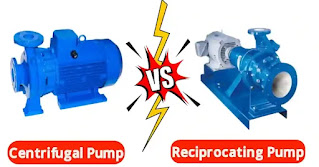
Difference Between Centrifugal Pump and Reciprocating
Pump
Centrifugal pumps and reciprocating pumps are two common
types of pumps that operate on different principles and have different
characteristics. Here are some of the key differences between centrifugal pumps
and reciprocating pumps:
- Working
principle: Centrifugal pumps work by converting mechanical energy into
kinetic energy, which is then used to move the fluid. Reciprocating pumps
work by using a piston, plunger, or diaphragm to create a pressure
difference that moves the fluid. - Flow
rate: Centrifugal pumps are typically used for high flow rate
applications, while reciprocating pumps are better suited for low flow
rate and high-pressure applications. - Pressure:
Reciprocating pumps are capable of generating much higher pressures than
centrifugal pumps, making them more suitable for applications where high
pressure is required. - Efficiency:
Centrifugal pumps are generally more efficient than reciprocating pumps
for higher flow rate applications. However, reciprocating pumps can be
more efficient for low flow rate applications, especially when dealing
with high viscosity fluids. - Maintenance:
Reciprocating pumps typically require more maintenance than centrifugal
pumps due to their more complex design and higher number of moving parts. - Cost:
Reciprocating pumps are generally more expensive than centrifugal pumps,
particularly for high flow rate applications.
Overall, the choice between a centrifugal pump and a
reciprocating pump depends on the specific requirements of the application,
including flow rate, pressure, efficiency, and cost.
Application of Centrifugal Pump
Centrifugal pumps are widely used in various applications
where high flow rates and moderate pressures are required. Some of the most
common applications of centrifugal pumps include:
- Water
supply: Centrifugal pumps are used to pump water from wells, lakes,
rivers, and other sources to supply water for municipal, industrial, and
agricultural uses. - HVAC
systems: Centrifugal pumps are used in heating, ventilation, and air
conditioning (HVAC) systems to circulate water or other fluids to provide
heating or cooling. - Wastewater
treatment: Centrifugal pumps are used to transport and process wastewater
in treatment plants, including pumping sewage sludge and wastewater
through the treatment process. - Chemical
processing: Centrifugal pumps are used in chemical processing applications
to transfer chemicals and other fluids between tanks, mixers, and
reactors. - Oil
and gas industry: Centrifugal pumps are used in the oil and gas industry
to transport crude oil, refined products, and natural gas through
pipelines and to pump drilling mud and other fluids during the drilling
process. - Agriculture:
Centrifugal pumps are used in irrigation systems to pump water from wells
or other sources to irrigate crops and fields. - Firefighting:
Centrifugal pumps are used in fire trucks and firefighting systems to pump
water or other fire retardants to extinguish fires.
Overall, centrifugal pumps are versatile and widely used in
many different applications that require the transfer of fluids.
What is Cavitation in Centrifugal Pump?
Cavitation is a common problem that can occur in centrifugal
pumps when the pressure at the inlet of the impeller falls below the vapor
pressure of the liquid being pumped. This causes the liquid to vaporize and
form small bubbles or cavities in the fluid. As these bubbles move towards the
higher pressure areas in the pump, they collapse or implode, creating shock
waves that can damage the pump components and reduce pump performance.

Cavitation can occur for a variety of reasons, including
high suction lift, high fluid viscosity, high pump speed, and inadequate NPSHa
(net positive suction head available). NPSHa is the difference between the
suction pressure and the vapor pressure of the liquid, and it represents the amount
of pressure available to keep the liquid from boiling.
The effects of cavitation can include noise, vibration,
reduced flow rate, decreased efficiency, and damage to pump components such as
impellers, volutes, and bearings. In severe cases, cavitation can lead to
complete pump failure.
To prevent cavitation, it is important to ensure that the
pump is properly designed and sized for the application, and that the NPSHa is
greater than the NPSHr (net positive suction head required) of the pump. NPSHr
is a characteristic of the pump and represents the minimum NPSHa required to
prevent cavitation. Other measures that can be taken to prevent cavitation
include reducing pump speed, increasing the diameter of the suction piping, and
reducing the fluid temperature or viscosity.
Advantages and Disadvantages of Centrifugal Pump
Centrifugal pumps have several advantages and disadvantages
that should be considered when selecting them for an application. Here are some
of the main advantages and disadvantages of centrifugal pumps:
Advantages:
- High
flow rate: Centrifugal pumps are capable of delivering high flow rates at
moderate pressures, which makes them ideal for applications that require
the transfer of large volumes of fluid. - Simple
design: Centrifugal pumps have a simple design that makes them easy to
install, operate, and maintain. They also have fewer moving parts than
other types of pumps, which reduces the risk of mechanical failure. - Low
cost: Centrifugal pumps are generally less expensive than other types of
pumps, which makes them an attractive option for applications that require
a cost-effective solution. - Efficient:
Centrifugal pumps are generally more efficient than other types of pumps,
especially at high flow rates. - Versatile:
Centrifugal pumps can be used for a wide range of applications, including
water supply, wastewater treatment, chemical processing, and many others.
Disadvantages:
- Limited
pressure: Centrifugal pumps are not well-suited for applications that
require high pressure, as they are typically unable to generate the same
level of pressure as other types of pumps. - Limited
suction lift: Centrifugal pumps are unable to lift fluid more than a
certain height above the pump’s inlet, which limits their usefulness in
some applications. - Cavitation:
Centrifugal pumps are prone to cavitation, which can damage the impeller
and reduce pump efficiency. - Sensitivity
to system changes: Centrifugal pumps are sensitive to changes in the
system, including changes in flow rate, pressure, and viscosity, which can
affect pump performance.
Overall, centrifugal pumps are widely used for their high
flow rate, simple design, and low cost. However, their limited pressure,
sensitivity to system changes, and tendency to cavitate are some of the
drawbacks to consider when selecting them for an application.
Methods of priming in Centrifugal Pump
Priming is the process of filling a centrifugal pump with
liquid to ensure it can start pumping. Here are some common methods of priming
a centrifugal pump:
- Manual
priming: This involves manually pouring liquid into the pump casing until
the impeller is submerged, and the suction line is filled with liquid.
This method is often used for smaller pumps. - Foot
valve priming: A foot valve is installed at the end of the suction line,
which prevents the liquid from flowing back out of the line once it has
been primed. When the pump is started, the liquid in the suction line is
pushed into the pump, and the pump is primed. - Vacuum
priming: A vacuum pump is used to create a vacuum in the pump casing,
which draws liquid up the suction line and into the pump. Once the pump is
primed, the vacuum pump is turned off, and the liquid is pumped normally. - Self-priming:
Self-priming centrifugal pumps have a special design that allows them to
prime themselves. These pumps have a chamber or reservoir that is filled
with liquid, and when the pump is started, the impeller creates a vacuum
that draws liquid up the suction line and into the pump. - External
priming: An external pump or compressor is used to push liquid into the
suction line and pump casing, priming the pump. This method is often used
for larger pumps that require a large volume of liquid to be primed.
Overall, the method of priming a centrifugal pump will
depend on the specific application and pump design. It is important to follow
the manufacturer’s recommendations for priming to ensure the pump operates
properly and efficiently.
Types of Casing in Centrifugal Pump
The casing of a centrifugal pump is the outer shell that
encloses the impeller and directs the flow of fluid through the pump. The
casing design can have a significant impact on pump performance, efficiency,
and maintenance requirements. Here are the three main types of casing in
centrifugal pumps:
- Volute
casing: This is the most common type of casing used in centrifugal pumps.
It has a spiral-shaped design that increases the flow area and reduces
fluid velocity as it flows from the impeller to the discharge port. The
volute casing provides a uniform flow of fluid with minimal turbulence,
making it ideal for high-flow, low-head applications. - Diffuser
casing: This casing type has a series of stationary vanes or diffusers
that are positioned around the impeller. These vanes help to direct the
flow of fluid and increase the pressure of the fluid as it moves from the
impeller to the discharge port. Diffuser casings are commonly used in
multistage centrifugal pumps, where multiple impellers are arranged in
series to achieve higher pressures. - Casing
with guide vanes: This type of casing has a set of guide vanes or blades
that are positioned around the impeller inlet. The guide vanes direct the
flow of fluid into the impeller and improve pump efficiency by reducing
turbulence and improving flow characteristics. This type of casing is
commonly used in high-head applications where high efficiency is critical.
Overall, the choice of casing type will depend on the
specific application and the pump design. Each casing type has its own
advantages and disadvantages, and the selection should be based on factors such
as flow rate, pressure, fluid characteristics, and efficiency requirements.
Manometric efficiency of Centrifugal Pump
The manometric efficiency of a centrifugal pump is a measure
of how efficiently the pump converts mechanical power input into fluid power
output. It is defined as the ratio of the head produced by the pump to the head
that would be produced if the pump were 100% efficient. The manometric
efficiency takes into account the losses that occur in the pump due to
friction, leakage, and other factors.
Mathematically, the manometric efficiency can be expressed
as:
Manometric efficiency = (Hm/ρQ) / (Ht/ρQ)
where Hm is the manometric head (the total head produced by
the pump), Ht is the theoretical head (the head that would be produced if the
pump were 100% efficient), ρ is the fluid density, and Q is the flow rate.
Typically, the manometric efficiency of a centrifugal pump
ranges from 50% to 90%, depending on the pump design, operating conditions, and
fluid properties. Factors that can affect the manometric efficiency include
impeller design, casing type, speed of rotation, viscosity of the fluid, and
inlet and outlet conditions.
It is important to note that the manometric efficiency is
not the same as the overall efficiency of the pump, which takes into account
the efficiency of the motor, the transmission system, and other components in addition
to the pump itself.
Read More: What is Reciprocating Pump? How many Types and what? Detailed Discussion