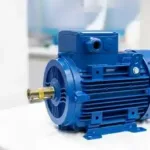
What is a centrifugal pump?
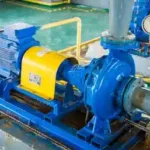
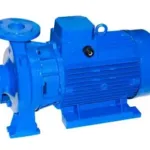
The pump which expels the fluid through the discharge channel under the influence of centrifugal force is called a centrifugal pump.
Description of Centrifugal Pump:
A Centrifugal pump is a rotating device consisting of two parts. These two parts are – the rotating part i.e. impeller and the stationary part i.e. pump casing. One or more impellers are attached to the pump shaft like discs. When the bearing shaft is rotated by an engine or electric motor, the impeller rotates with it.
Diffuser-type centrifugal pumps are fitted with diffusers or guide vanes around which the impeller rotates. In a centrifugal pump, the impeller rotates in a closed chamber to drive water towards the center and then expels the water from the casing to the discharge pipe by centrifugal force.
What is the reciprocating pump?
Description of Reciprocating Pump:
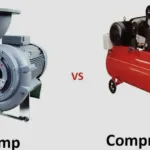
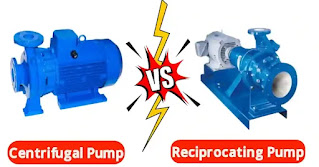
Difference between Centrifugal pump and Reciprocating pump:
table.GeneratedTable {
width: 100%;
background-color: #ffffff;
border-collapse: collapse;
border-width: 1px;
border-color: #000000;
border-style: solid;
color: #000000;
}
table.GeneratedTable td, table.GeneratedTable th {
border-width: 1px;
border-color: #000000;
border-style: solid;
padding: 3px;
}
table.GeneratedTable thead {
background-color: #ffff00;
}
| SL.No. | Centrifugal Pump | Reciprocating pump |
|---|---|---|
| 1 | Simple construction. | Complicated construction due to air vessel, non-return valve. |
| 2 | It is used for more discharge and less head. | It is used for low discharge and high head. |
| 3 | Requires priming. | No priming is required. |
| 4 | ‘s delivery is continuous. | ‘s delivery is fluctuating. |
| 5 | It runs at a higher speed. | It does not run at high speed. |
| 6 | This pump reduces wear and tear. | This pump is prone to wear and tear. |
| 7 | Lightweight and simple installation. | Weighs more and installation is complicated. |
| 8 | It can be used for lifting highly viscous liquids. | Only used for lifting pure water or low viscosity liquids. |
| 9 | Low initial and maintenance costs. | Initial and maintenance cost is high. |
| 10 | The supply of this pump is usually continuous. | The supply to this pump is usually not continuous. |
| 11 | More heads and less efficiency at less discharge. | Efficiency is higher with more head and less discharge. |
| 12 | It does not require a pump air vessel. | This pump requires an air vessel. |
| 13 | This pump requires less space and a simple foundation for installation. | This pump requires more space and a strong foundation to install. |
| 14 | Lower pump weight for equivalent emissions. | The equivalent emission of the pump weighs more. |
| 15 | It’s easy to run. | It requires caution to run. |
| 16 | It can handle large amounts of liquid. | It can only carry a small amount of liquid. |
| 17 | Centrifugal pumps can handle dirty water. | Reciprocating pumps cannot handle dirty water. |
| 18 | It is used for pumping highly viscous liquids. | It is used for pumping low-viscosity liquids. |
| 19 | Its structure is simple and the weight is light due to fewer parts. | Its structure is complex and the weight is high due to a large number of parts. |
| 20 | It is mostly used for domestic purposes. | These are mostly used in industry. |
| 21 | Low wear and tear. | Usage damage is high. |
| 22 | Its working method is simple. | Its mechanism of action is relatively complex. |
| 23 | It continuously drains fluid. | It does not continuously drain liquid. |
| 24 | Low maintenance cost. | High maintenance cost. |
| 25 | A centrifugal pump is a rotary pump that uses the kinetic energy of an impeller. | The reciprocating pump is a positive displacement type pump driven by a piston. |
| 26 | Has low performance. | Has more performance. |