What is Benson Boiler?
The Benson Boiler is a high-pressure, water tube boiler used
in power plants to generate steam. It was invented by the German engineer Mark
Benson in 1922 and has since been widely used in power plants around the world.
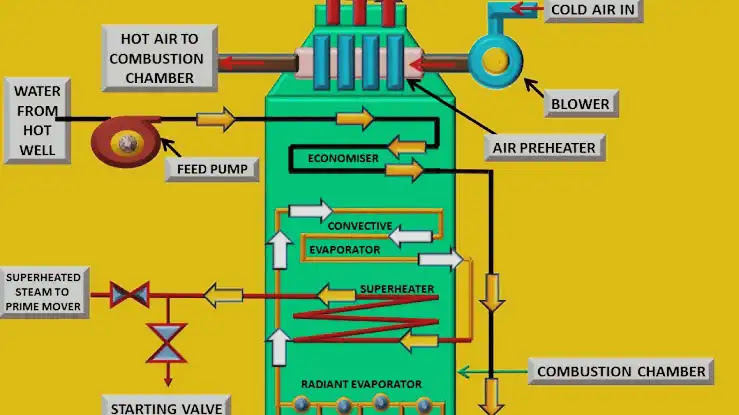
The Benson Boiler works on the principle of forced
circulation, in which water is circulated through the tubes of the boiler under
high pressure. This creates a supercritical condition, in which the water
exists as a single phase, neither liquid nor gas. At this state, the water has
a higher thermal efficiency and can transfer more heat to the working fluid,
which is typically steam.
One of the main advantages of the Benson Boiler is its
ability to operate at higher pressures and temperatures than traditional
boilers, resulting in greater efficiency and power output. It is also known for
its quick start-up time and its ability to handle rapid load changes.
However, the Benson Boiler requires specialized materials to
withstand the high pressures and temperatures, making it more expensive to
build and maintain than other types of boilers. It also requires a high level
of expertise and training to operate and maintain properly.
Overall, the Benson Boiler has been a significant
development in the field of power plant technology, and it remains an important
option for power generation today.
Parts of Benson Boiler:
The Benson Boiler is a type of water tube boiler used in
power plants to generate steam. It consists of several parts, including:
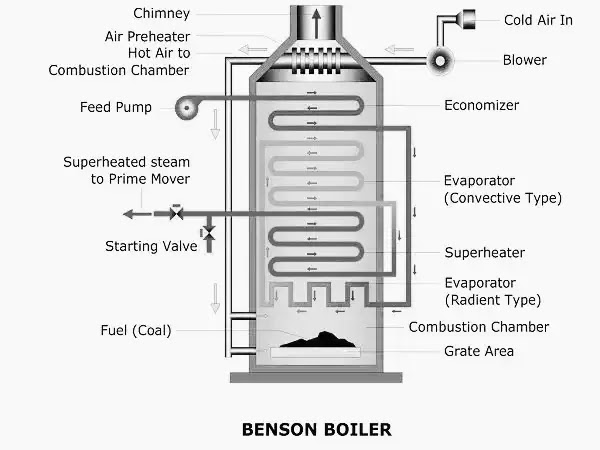
- Steam
drum: The steam drum is a large cylindrical vessel located at the top of
the boiler, where the steam is collected and sent to the turbine. - Water
walls: The water walls are a series of tubes that are located in the
furnace and filled with water. The water absorbs the heat generated by the
combustion of fuel and is converted into steam. - Downcomers:
The downcomers are pipes that carry water from the steam drum to the water
walls, ensuring that there is a constant flow of water through the system. - Burners:
The burners are located in the furnace and are used to ignite the fuel and
generate heat. - Supercritical
boiler tubing: The tubing is made from specialized materials that can
withstand the high pressures and temperatures of the supercritical state.
The tubing is designed to maximize heat transfer and increase efficiency. - High-pressure
feedwater pump: The high-pressure feedwater pump is used to pump water
into the boiler at high pressure. - Economizer:
The economizer is a heat exchanger that recovers heat from the flue gases
before they are discharged into the atmosphere. The recovered heat is used
to preheat the feedwater, reducing the amount of fuel required to heat the
water.
Overall, the Benson Boiler is a complex system that requires
careful design, construction, and maintenance to operate efficiently and
safely. Each part of the system plays a critical role in the generation of
steam and the conversion of fuel into energy.
Working Principle of Benson Boiler:
The working principle of the Benson Boiler is based on the
principle of forced circulation and the supercritical state of water. The
supercritical state refers to the point at which water exists as a single
phase, neither liquid nor gas, due to the high pressure and temperature.
The Benson Boiler works by feeding water under pressure into
the boiler, where it is heated to the supercritical state. The heated water is
then sent to the steam drum, where it is separated from the steam. The steam is
collected and sent to the turbine to generate electricity, while the water is
returned to the boiler through the downcomers.
In the Benson Boiler, there are no steam and water
separators like in other boilers. The water is heated to the supercritical
state and remains in a single-phase, ensuring that the heat transfer from the
furnace to the water is more efficient. This allows the Benson Boiler to
operate at higher temperatures and pressures, resulting in greater efficiency
and power output.
The Benson Boiler uses a high-pressure feedwater pump to
maintain a constant flow of water through the system. The water is circulated
through the water walls, where it absorbs heat from the combustion of fuel. The
supercritical boiler tubing is designed to maximize heat transfer and increase
efficiency.
The economizer is also an essential part of the Benson
Boiler, which recovers heat from the flue gases before they are discharged into
the atmosphere. The recovered heat is used to preheat the feedwater, reducing
the amount of fuel required to heat the water.
Overall, the working principle of the Benson Boiler is based
on creating a supercritical state of water, where the water is heated to a
single-phase, and the heat transfer is maximized to generate steam efficiently
and at a high power output.
Construction of Benson Boiler:
The Benson boiler is a type of high-pressure water tube
boiler used in power plants. It was developed by Mark Benson in Germany in the
early 20th century. The Benson boiler operates at pressures above the critical
point of water, which means that the water does not undergo a phase change to
steam. Instead, it exists as a homogeneous mixture of water and steam.
Here are the basic components and construction of a Benson
boiler:
- Water
walls: The water walls are vertical tubes filled with water. These tubes
form a barrier between the combustion gases and the water inside the
boiler. - Water
supply system: Water is supplied to the boiler through a feedwater pump.
The water is then preheated in a preheater before entering the boiler. - Burners:
Fuel is burned in the burners to produce high-temperature combustion
gases. These gases flow around the water walls, heating the water inside
the tubes. - Superheater:
The superheater is a set of tubes located in the upper part of the boiler.
The combustion gases pass over the superheater tubes, heating them to a
very high temperature. The steam/water mixture in the lower part of the
boiler is then sent through the superheater tubes, where it is heated
further and converted into dry steam. - Separator:
The separator is located above the superheater tubes. It separates the
steam from the water and sends the dry steam to the turbine. - Economizer:
The economizer is a set of tubes located in the exhaust gas stream. It
preheats the feedwater before it enters the boiler.
The Benson boiler is unique in that it does not have a drum.
Instead, the water/steam mixture flows through the tubes, which allows for
higher efficiency and a smaller overall size compared to traditional drum-type
boilers.
Working of Benson Boiler:
The Benson boiler is a high-pressure water tube boiler that
operates at pressures above the critical point of water. This means that the
water in the boiler exists as a homogeneous mixture of water and steam, rather
than undergoing a phase change to steam.
The working of a Benson boiler can be explained in the
following steps:
- Water
is supplied to the boiler through a feedwater pump and preheated in a
preheater before entering the boiler. - The
fuel is burned in the burners, producing high-temperature combustion
gases. These gases flow around the water walls, heating the water inside
the tubes. - The
water/steam mixture in the tubes flows upward through the tubes, absorbing
heat from the combustion gases. The mixture continues to heat up and reach
the critical point of water, where the water and steam become
indistinguishable. - The
mixture of water and steam then enters the superheater section of the
boiler, which is located in the upper part of the boiler. The combustion
gases pass over the superheater tubes, heating them to a very high
temperature. The mixture of water and steam flows through the superheater
tubes, where it is heated further and converted into dry steam. - The
steam then passes through the separator, which separates the steam from
the remaining water droplets. The dry steam is then sent to the turbine to
generate electricity. - The
remaining water droplets are recycled back to the water supply system to
be heated and converted to steam again.
The Benson boiler operates at higher efficiencies compared to
traditional drum-type boilers because it does not have a drum and the
water/steam mixture flows through the tubes. This design reduces the thermal
stress on the boiler components, allowing for higher operating pressures and
temperatures. Additionally, the absence of a drum reduces the size and weight
of the boiler, making it suitable for power generation applications with
limited space.
Advantages and Disadvantages of Benson Boiler
Advantages of Benson Boiler:
- High
Efficiency: The Benson boiler operates at higher efficiencies compared to
traditional drum-type boilers due to its unique design. The absence of a
drum reduces thermal stress on the boiler components, allowing for higher
operating pressures and temperatures. - Compact
Size: The Benson boiler is more compact and lighter than other boilers of
similar output, making it suitable for power generation applications with
limited space. - Faster
Start-up Time: The Benson boiler has a faster start-up time compared to
other boilers, which means that it can be brought online quickly when
there is a sudden increase in demand for electricity. - High
Output: The Benson boiler is capable of generating high amounts of steam,
making it suitable for large power plants.
Disadvantages of Benson Boiler:
- High
Maintenance Cost: The Benson boiler has a complex design, which can make
it more expensive to maintain compared to other boilers. - Limited
Operating Range: The Benson boiler can only operate within a narrow range
of pressure and temperature, which makes it less flexible than other types
of boilers. - Susceptible
to Water Quality Issues: The Benson boiler is sensitive to water quality
issues, such as impurities or high levels of dissolved solids, which can
cause scaling and corrosion in the boiler tubes. - High
Initial Cost: The Benson boiler has a high initial cost compared to other
boilers, which may be a barrier to its adoption in certain applications.
Overall, the Benson boiler is a highly efficient and compact
boiler that is suitable for large power plants. However, it also has some
disadvantages that should be considered when selecting a boiler for a
particular application.
Applications of Benson Boiler:
Benson boilers are typically used in large power plants
where high-pressure, high-temperature steam is required for electricity
generation. Here are some of the main applications of Benson boilers:
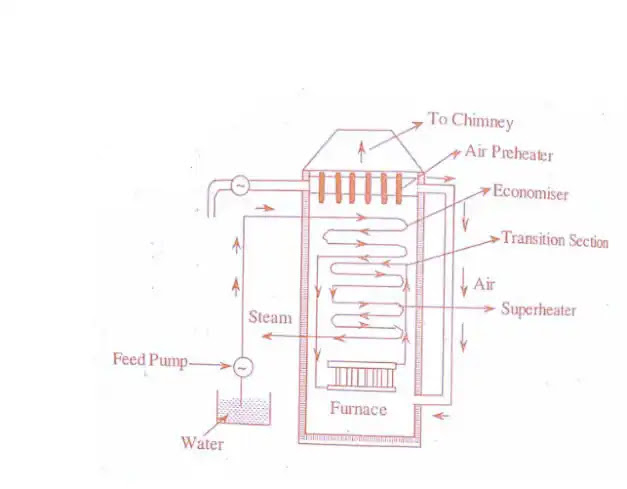
- Power
Generation: Benson boilers are widely used in power plants for electricity
generation. They can produce high-pressure, high-temperature steam, which
is used to drive steam turbines and generators. - Industrial
Processes: Benson boilers are also used in various industrial processes
that require high-pressure steam, such as chemical processing, food
processing, and paper manufacturing. - Combined
Heat and Power (CHP) Plants: Benson boilers can be used in combined heat
and power (CHP) plants, which generate both electricity and heat. The
high-pressure steam produced by the Benson boiler can be used for industrial
processes or for district heating. - Geothermal
Power Plants: Benson boilers can also be used in geothermal power plants,
where they are used to generate steam from the hot water extracted from
geothermal reservoirs.
Overall, Benson boilers are ideal for applications that
require high-pressure, high-temperature steam and are widely used in power
generation and various industrial processes.
Features of Benson Boiler
Here are some of the key features of a Benson Boiler:
- Forced
Circulation: Benson boilers use forced circulation to circulate water
through the boiler tubes, which increases the heat transfer rate and
improves efficiency. - Once-Through
Design: Benson boilers have a once-through design, which means that water
and steam flow through the boiler only once, without any recirculation.
This design reduces the risk of tube overheating and increases the steam
quality. - High-Pressure
Operation: Benson boilers operate at very high pressures, typically above
200 bar, and can generate superheated steam at temperatures above 500°C. - Compact
Size: Benson boilers are more compact and lighter than other boilers of
similar output, making them suitable for power generation applications
with limited space. - Quick
Start-Up: Benson boilers have a fast start-up time, which means that they
can be brought online quickly when there is a sudden increase in demand
for electricity. - High
Efficiency: Benson boilers operate at higher efficiencies compared to
traditional drum-type boilers due to their unique design, which reduces
thermal stress on the boiler components, allowing for higher operating
pressures and temperatures.
Overall, Benson boilers are known for their high-pressure
operation, once-through design, high efficiency, and compact size, making them
suitable for power generation applications with limited space and high-demand
for steam.
Read More: Locomotive Boiler: Definition, Parts, Working Principle, Advantages, Application