What is LDR?
LDR can stand for multiple things depending on the context,
but one common meaning is “Light Dependent Resistor.”
A Light Dependent Resistor (LDR), also known as a
photoresistor, is a type of sensor that changes its resistance depending on the
amount of light that falls on it. LDRs are made of a semiconductor material,
such as cadmium sulfide, which has the property of changing its electrical
resistance when exposed to light. LDRs are used in various applications,
including light meters, camera exposure control, street light control, and
burglar alarm systems.
Types of Photoresistor ( LDR )
Photo resistors (LDRs) can be classified into two types
depending on the materials used to build them. The two types of photo resistors
include:
1.
Intrinsic Photoresistor: Pure semiconductor
materials like silicon or germanium can be used to create intrinsic
photoconductors. When photons with enough energy fall on these materials, electrons
are excited from the valence band to the conduction band, resulting in an
increase in the number of charge carriers.
2.
Extrinsic Photoresistor: A photoresistor, also
known as a light-dependent resistor (LDR), is an extrinsic photoconductor made
of an extrinsic semiconductor material. Extrinsic semiconductors are created by
introducing impurities, also known as dopants, into a pure semiconductor
material to change its electrical properties. In the case of photoresistors,
extrinsic semiconductors such as cadmium sulfide or lead sulfide are doped with
impurities to create p-n junctions, which are regions where the p-type and
n-type regions meet. When light falls on the p-n junction of a photoresistor,
electron-hole pairs are generated, which results in a decrease in resistance.
The amount of light that is detected by the photoresistor determines the number
of electron-hole pairs created and hence the resistance of the photoresistor. Thus,
a photoresistor is an extrinsic photoconductor that exhibits a change in
resistance with changes in light intensity, and its behavior is determined by
the properties of the extrinsic semiconductor material from which it is made.
Working principle of LDR
LDRs (Light Dependent Resistors) are passive electronic
components that change their resistance based on the amount of light that falls
on them. The working principle of an LDR can be explained in the following
steps:
- In the
absence of light, the LDR behaves like a typical resistor and offers a
certain resistance to the flow of electric current. - When
light falls on the LDR, some of the photons are absorbed by the material
of the LDR, which causes the electrons in the material to become excited
and move to a higher energy level. - This
results in a decrease in the resistance of the LDR, as more charge
carriers become available to conduct the current. - The
amount of resistance offered by the LDR decreases as the amount of light
falling on it increases. - The
change in resistance of the LDR can be measured by connecting it to a
circuit and measuring the voltage across it or the current through it. - This
change in resistance can be used to trigger various electronic devices,
such as switches, alarms, and light sensors.
Overall, the working principle of an LDR is based on its
ability to change its resistance in response to changes in light intensity.
This property makes LDRs useful in a wide range of applications, from automatic
lighting control to photography and security systems.
Applications of Photoresistor (LDRs)
Photoresistors, or LDRs, are widely used in various
applications that require the detection of light or changes in light intensity.
Here are some common applications of photoresistors:
- Automatic
lighting control: Photoresistors are commonly used in streetlights,
outdoor lighting, and indoor lighting systems to detect the ambient light
level and automatically adjust the brightness of the light source. - Photography:
Photoresistors are used in cameras and light meters to measure the amount
of light available and adjust the exposure time accordingly. - Security
systems: Photoresistors are used in security systems to detect changes in
light levels and trigger alarms if there is any significant change. - Consumer
electronics: Photoresistors are used in a variety of consumer electronics,
such as smartphones, digital watches, and remote controls, to detect
changes in ambient light and adjust the display brightness or backlight
accordingly. - Industrial
automation: Photoresistors are used in industrial automation systems to
detect the presence or absence of objects, as well as to monitor
production lines, detect faults, and control the movement of machinery. - Robotics:
Photoresistors are used in robotics to detect light and avoid obstacles or
navigate through environments. - Solar
panels: Photoresistors are used in solar panels to detect changes in light
levels and adjust the orientation of the panel for maximum efficiency.
Overall, photoresistors are essential components in many
electronic systems that require light sensing and control.
Difference between LDR and LED
LDRs (Light Dependent Resistors) and LEDs (Light Emitting
Diodes) are two different electronic components that are used in different ways
to interact with light.
The main difference between an LDR and an LED is that an LDR
is a passive device that detects changes in light intensity, while an LED is an
active device that emits light when an electric current is passed through it.
An LDR is a type of resistor that changes its resistance
depending on the amount of light that falls on it. The resistance of an LDR
decreases as the amount of light falling on it increases. LDRs are commonly
used in applications such as automatic lighting control, photography, and
security systems.
On the other hand, an LED is a semiconductor device that
emits light when a voltage is applied to it. LEDs are commonly used in
lighting, displays, and indicator lights. LEDs are available in a range of
colors, and their brightness can be controlled by varying the amount of current
flowing through them.
In summary, LDRs are used to detect changes in light
intensity, while LEDs emit light when a voltage is applied to them. LDRs are
passive devices, while LEDs are active devices.
Here is a table summarizing the differences between LDRs and
LEDs:
|
Aspect |
LDR |
LED |
|
Type of |
Passive |
Active |
|
Function |
Detects |
Emits |
|
Resistance |
Increases |
N/A |
|
Application |
Automatic |
Lighting, |
|
Material |
Semiconductors |
Semiconductors |
|
Range |
N/A |
Available |
|
Brightness |
N/A |
Can be |
|
Power |
Low |
Low |
Overall, LDRs and LEDs are two different types of electronic
components with distinct functions and applications. While LDRs detect changes
in light intensity, LEDs emit light when a voltage is applied.
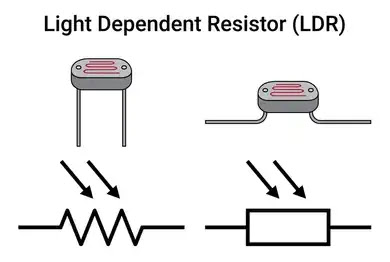
LDR Symbol
Parts of LDR
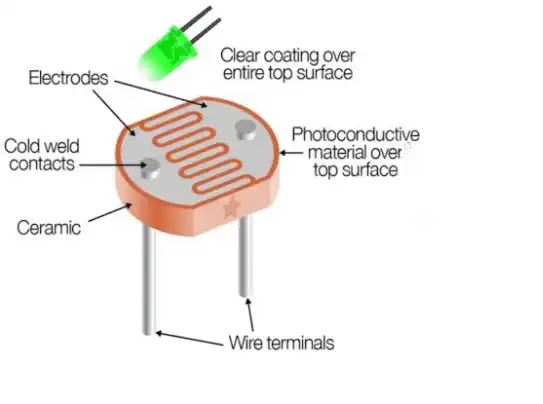
LDRs (Light Dependent Resistors) are relatively simple
devices that consist of only a few parts. The main parts of an LDR include:
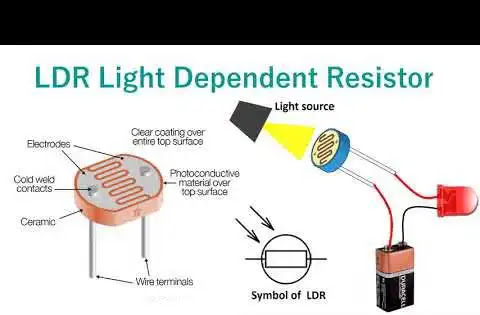
- Semiconductor
material: LDRs are made up of semiconductor materials, such as cadmium
sulfide or lead sulfide. These materials have the property of changing
their resistance in response to changes in light intensity. - Encapsulating
material: The semiconductor material of the LDR is usually enclosed in a
protective casing made of glass, plastic or metal, to protect it from
external factors such as humidity, dust or temperature changes. - Electrical
contacts: LDRs have two electrical contacts that are attached to either
end of the semiconductor material. These contacts allow the LDR to be
connected to an electrical circuit and measure the change in resistance as
the light intensity changes.
Overall, LDRs are simple devices that rely on the properties
of semiconductor materials to detect changes in light intensity. The
encapsulating material and electrical contacts are used to protect and connect
the semiconductor material to an electrical circuit.
Advantages and Disadvantages of LDR
Advantages of LDRs (Light Dependent Resistors):
- Simple
and easy to use: LDRs are relatively simple electronic components that can
be easily incorporated into a wide range of circuits and devices. - Low
cost: LDRs are relatively inexpensive and widely available, making them a
popular choice for many applications. - Wide
range of resistance: LDRs can exhibit a wide range of resistance values,
which makes them suitable for use in many different types of circuits and
devices. - Sensitive
to light: LDRs can detect even small changes in light intensity, making
them useful in applications such as automatic lighting control and light
sensors.
Disadvantages of LDRs:
- Slow
response time: LDRs can have a relatively slow response time, which may
make them unsuitable for some applications where rapid changes in light
intensity need to be detected. - Limited
spectral range: LDRs can only detect light within a certain range of
wavelengths, which may make them unsuitable for some specialized
applications. - Nonlinear
response: LDRs do not exhibit a linear response to changes in light
intensity, which can make them more difficult to calibrate and use in
certain types of circuits. - Temperature
dependent: LDRs can be affected by changes in temperature, which may
require additional circuitry or calibration to compensate for these
changes.
Overall, LDRs are simple and cost-effective electronic
components that are well-suited for a wide range of applications. However,
their slow response time and limited spectral range may make them unsuitable
for certain specialized applications.