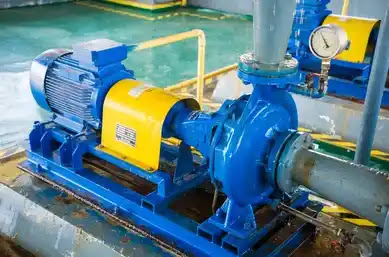
What is Reciprocating Pump?
A reciprocating pump is a type of positive displacement pump
that uses a reciprocating motion to transfer fluids. It works by using a piston
or plunger to draw in and then expel fluid from a chamber through a one-way
valve system. The motion of the piston creates a pressure differential that
forces the fluid to move through the pump.
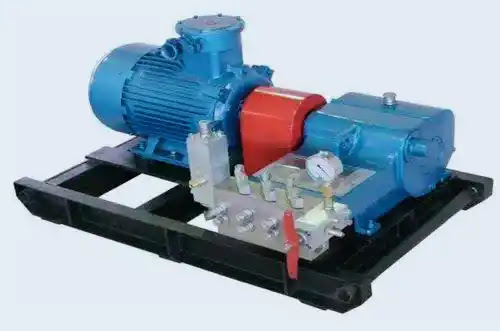
Reciprocating pumps are commonly used in a variety of
applications, including oil and gas, chemical processing, water treatment, and
food processing. They are particularly useful for pumping high-viscosity
fluids, such as oil and molasses, and for applications requiring precise flow
control.
One of the advantages of reciprocating pumps is that they
can generate high pressures with relatively low flow rates, making them ideal
for applications requiring high-pressure pumping. However, they can also be
relatively complex and require regular maintenance to ensure reliable
operation.
Parts of Reciprocating Pump
A reciprocating pump consists of several parts, including:
- Cylinder:
The cylinder is the main component of the reciprocating pump, and it
houses the piston or plunger that moves back and forth to create the
pumping action. - Piston
or Plunger: The piston or plunger is a movable component inside the
cylinder that is responsible for creating the pumping action. It moves
back and forth inside the cylinder, drawing in and expelling fluid through
the pump. - Inlet
and Outlet Valves: The inlet and outlet valves are one-way valves that
control the flow of fluid into and out of the pump. The inlet valve opens
when the piston or plunger moves to the left, allowing fluid to enter the
cylinder, while the outlet valve opens when the piston or plunger moves to
the right, allowing fluid to exit the cylinder. - Crankshaft:
The crankshaft is a rotating component that is used to convert the
reciprocating motion of the piston or plunger into rotational motion. It
is typically driven by an electric motor or engine. - Connecting
Rod: The connecting rod is a component that connects the piston or plunger
to the crankshaft. It transfers the reciprocating motion of the piston or
plunger to the rotational motion of the crankshaft. - Packing
Gland: The packing gland is a component that seals the gap between the
cylinder and the piston or plunger, preventing fluid from leaking out of
the pump. - Drive
Mechanism: The drive mechanism is the component that provides the power to
drive the pump, typically an electric motor or engine.
Working Principle of Reciprocating Pump
The working principle of a reciprocating pump is based on
the principle of positive displacement, which means that a fixed amount of
fluid is transferred per cycle of operation. Here is a general overview of the working
principle of a reciprocating pump:
- During
the suction stroke, the piston or plunger moves away from the cylinder
head, creating a vacuum inside the cylinder. This vacuum causes the inlet
valve to open, and the fluid to be drawn into the cylinder. - As the
piston or plunger moves back towards the cylinder head during the
discharge stroke, the inlet valve closes, and the fluid is forced out of
the cylinder through the outlet valve. - The
reciprocating motion of the piston or plunger is converted into rotary
motion by a connecting rod and a crankshaft, which turns the rotational
motion into the desired output, such as a pump shaft. - The
process is repeated as the piston or plunger continues to move back and
forth, drawing in fluid during the suction stroke and discharging it
during the discharge stroke.
The inlet and outlet valves are typically check valves,
which ensure that the fluid flows in one direction only. The flow rate of the
pump is determined by the size of the piston or plunger, the speed of the pump,
and the pressure differential across the pump.
Working of Reciprocating Pump
The working of a reciprocating pump can be explained in
detail as follows:

- During
the suction stroke, the piston or plunger moves away from the cylinder
head, creating a low-pressure zone inside the cylinder. This low-pressure
zone causes the inlet valve to open, allowing the fluid to enter the
cylinder. - As the
piston or plunger moves back towards the cylinder head during the
discharge stroke, the inlet valve closes, and the fluid is forced out of
the cylinder through the outlet valve. The outlet valve opens as the
pressure inside the cylinder increases, allowing the fluid to be
discharged from the pump. - The
reciprocating motion of the piston or plunger is converted into rotary
motion by the connecting rod and crankshaft. The crankshaft turns the
rotational motion into the desired output, such as a pump shaft. - The
pump continues to operate by repeating the suction and discharge strokes.
The inlet and outlet valves are designed to ensure that the fluid flows in
one direction only. - The
flow rate of the pump is determined by the size of the piston or plunger,
the speed of the pump, and the pressure differential across the pump. A
higher pressure differential across the pump results in a higher flow
rate. - The
performance of the pump can be affected by various factors such as the
viscosity and temperature of the fluid, the condition of the valves and
seals, and the alignment and balance of the pump components.
Reciprocating pumps are commonly used in a variety of
applications, including oil and gas, chemical processing, water treatment, and
food processing. They are particularly useful for pumping high-viscosity
fluids, such as oil and molasses, and for applications requiring precise flow
control.
Types of Reciprocating Pump
There are several types of reciprocating pumps, each
designed for specific applications. Some of the most common types of
reciprocating pumps include:
- Piston
Pumps: Piston pumps are the most common type of reciprocating pump. They
use a piston to create pressure and move the fluid through the pump.
Piston pumps can be single-acting or double-acting, depending on whether
they pump fluid during both the up and down strokes or only during the
down stroke. - Plunger
Pumps: Plunger pumps are similar to piston pumps, but they use a plunger
instead of a piston. The plunger is typically longer and narrower than a
piston, and it moves back and forth to create the pumping action. - Diaphragm
Pumps: Diaphragm pumps use a flexible diaphragm to create pressure and
move the fluid through the pump. The diaphragm is typically made of rubber
or other flexible material, and it moves back and forth in response to
changes in pressure. - Duplex
Pumps: Duplex pumps are reciprocating pumps that have two pumping
chambers, each with its own piston or plunger. The two chambers are
typically arranged in parallel, allowing the pump to operate continuously
even if one chamber is being serviced. - Triplex
Pumps: Triplex pumps are similar to duplex pumps, but they have three
pumping chambers instead of two. The three chambers are typically arranged
in a triangle, with each chamber operating out of phase with the others to
provide a more constant flow of fluid. - Quintuplex
Pumps: Quintuplex pumps are similar to triplex pumps, but they have five
pumping chambers instead of three. The five chambers are typically
arranged in a pentagon, with each chamber operating out of phase with the
others to provide an even more constant flow of fluid.
Each type of reciprocating pump has its own advantages and
disadvantages, depending on the application and specific requirements.
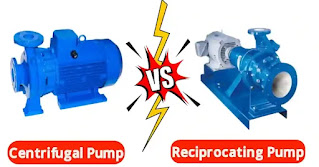
Difference Between Reciprocating Pump and Centrifugal Pump
Reciprocating pumps and centrifugal pumps are two types of
pumps used to transfer fluids in various applications. The main differences
between these two types of pumps are:
- Working
principle: Reciprocating pumps work by using a reciprocating motion to
create a flow of fluid through the pump, while centrifugal pumps use a
rotating impeller to create a flow of fluid. - Flow
rate: Centrifugal pumps are capable of delivering a high flow rate at a
relatively low pressure, while reciprocating pumps are capable of
delivering a lower flow rate at a higher pressure. - Pressure:
Reciprocating pumps can generate high pressure at relatively low flow
rates, while centrifugal pumps are better suited for applications that
require moderate pressure and high flow rates. - Efficiency:
Centrifugal pumps are generally more efficient than reciprocating pumps,
especially at high flow rates. - Maintenance:
Reciprocating pumps require more maintenance than centrifugal pumps due to
their complex design and the need to replace valves and other parts
regularly. - Noise:
Reciprocating pumps tend to produce more noise and vibration than
centrifugal pumps, which can be a concern in some applications. - Applications:
Reciprocating pumps are commonly used in applications that require high
pressure and low flow rates, such as in hydraulic systems, while
centrifugal pumps are more suitable for applications that require high
flow rates and moderate pressure, such as in HVAC systems, water supply,
and wastewater treatment.
Overall, the choice between a reciprocating pump and a
centrifugal pump depends on the specific application requirements and the
trade-offs between flow rate, pressure, efficiency, maintenance, and other
factors.
Application of Reciprocating Pumps
Reciprocating pumps have a wide range of applications in
various industries due to their ability to generate high pressures and their
ability to handle a wide range of fluids, including viscous and corrosive
fluids. Some common applications of reciprocating pumps include:

- Oil
and Gas: Reciprocating pumps are commonly used in the oil and gas industry
for pumping crude oil, natural gas, and other fluids. They are often used
for high-pressure applications such as injection wells and pipeline
transfer. - Chemical
Processing: Reciprocating pumps are used in chemical processing to pump
various chemicals, acids, and bases. They are often used for metering and
dosing applications due to their ability to precisely control flow rates. - Water
Treatment: Reciprocating pumps are used in water treatment plants for
pumping water, sludge, and other fluids. They are often used for
high-pressure applications such as reverse osmosis and filtration. - Food
Processing: Reciprocating pumps are used in food processing for pumping
viscous fluids such as chocolate, honey, and syrup. They are also used for
metering and dosing applications in the production of food additives and
preservatives. - Pharmaceutical:
Reciprocating pumps are used in pharmaceutical production for pumping
high-viscosity fluids, including vaccines and suspensions. They are also
used for metering and dosing applications in the production of medicines
and drugs. - Mining:
Reciprocating pumps are used in the mining industry for pumping slurry and
other abrasive fluids. They are often used in underground mining
operations due to their ability to handle harsh and corrosive environments.
Overall, the application of reciprocating pumps is
widespread, and they are used in various industries for pumping a wide range of
fluids in both high and low-pressure applications.
Advantages and Disadvantages of Reciprocating Pump
Advantages of Reciprocating Pump:
- High
Pressure: Reciprocating pumps are capable of generating very high
pressures, making them suitable for applications requiring high-pressure
fluid delivery. - Versatility:
Reciprocating pumps can handle a wide range of fluids, including viscous
and abrasive fluids, making them suitable for use in many different
applications. - Metering
Capability: Reciprocating pumps can accurately control flow rates, making
them suitable for applications requiring precise flow control. - Self-priming:
Reciprocating pumps can often self-prime, meaning they can draw fluid from
a lower level without the need for a separate priming system. - Durable:
Reciprocating pumps are typically very durable and long-lasting, with a
lifespan that can last for many years.
Disadvantages of Reciprocating Pump:
- Maintenance:
Reciprocating pumps require regular maintenance to ensure optimal
performance and prevent breakdowns. This can include replacing seals,
checking valve clearances, and monitoring fluid levels. - Complex
Design: Reciprocating pumps have a complex design with many moving parts,
which can make them more prone to breakdowns and require more frequent
maintenance. - Noise
and Vibration: Reciprocating pumps can produce significant noise and
vibration, which can be a concern in some applications. - Energy
Consumption: Reciprocating pumps can be less energy-efficient than other
types of pumps, which can result in higher operating costs. - Cost:
Reciprocating pumps can be more expensive than other types of pumps,
especially for high-pressure or high-capacity applications.
Overall, the advantages and disadvantages of reciprocating
pumps depend on the specific application and requirements of the pump system.
Careful consideration of the advantages and disadvantages can help in selecting
the appropriate pump for the application.