TIG
welding (Tungsten Inert Gas welding) is a type of arc welding process that uses
a non-consumable tungsten electrode to produce the weld. The process involves
creating an electric arc between the tungsten electrode and the metal being
welded, which melts the metal and fuses it together with the help of a filler
rod. The term “inert gas” in TIG welding refers to the use of an
inert gas, such as argon or helium, to shield the weld from contamination by
the surrounding air. This process produces very precise and high-quality welds,
making it popular in industries such as aerospace, automotive, and metal
fabrication. TIG welding is often used to weld thin sections of stainless
steel, aluminum, magnesium, and copper alloys.
Process
of Tig Welding
The
process of TIG welding (Tungsten Inert Gas welding) involves the following
steps:
Preparation: Before starting
the TIG welding process, the workpiece must be cleaned and prepared. The
surfaces to be welded should be free of any contaminants, such as rust,
oil, or paint. The edges of the workpiece should be chamfered or beveled
to provide good penetration for the weld.
Setup: The TIG welding machine
must be set up correctly before welding can begin. The correct type and
size of tungsten electrode and filler rod must be selected, and the
welding machine must be set to the appropriate current and polarity for
the material being welded. The shielding gas flow rate should also be set
correctly.
Tungsten Electrode
Preparation: The tungsten electrode must be sharpened to a point using a
grinding wheel or a dedicated tungsten electrode sharpener. The shape and
size of the electrode tip will depend on the welding application and the
thickness of the material being welded.
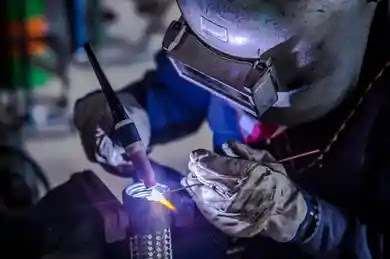
Welding: The TIG welding
process involves striking an arc between the tungsten electrode and the
workpiece using a foot pedal or torch switch. The welder must then
maintain the arc and control the weld pool while feeding the filler rod
into the weld zone. The welder must maintain a consistent distance between
the tungsten electrode and the workpiece, as well as the correct angle of
the electrode to produce a high-quality weld.
Shielding Gas: A continuous
flow of shielding gas, typically argon or helium, is used to protect the
weld pool from contamination by the surrounding air. The flow rate of the
shielding gas should be set to the appropriate level for the welding
application.
Finishing: Once the welding is
complete, the weld area should be cleaned and inspected for any defects,
such as cracks or porosity. Any excess filler rod should be removed, and
the weld should be finished to the required surface finish.
Overall,
the TIG welding process requires a high level of skill and experience to
produce high-quality, precise welds. The welder must be able to control the arc
and weld pool while maintaining the correct angle and distance between the
tungsten electrode and the workpiece.
Advantages
and Disadvantages of Tig Welding
TIG
welding (Tungsten Inert Gas welding) has several advantages and disadvantages,
which are:
Advantages:
High Quality Welds: TIG
welding produces high-quality, precise, and clean welds, making it
suitable for welding thin sections and materials that require high
accuracy and aesthetic finishes.
Versatility: TIG welding can
be used to weld a wide range of materials, including stainless steel,
aluminum, copper, brass, and exotic alloys.
Control: The welder can
precisely control the heat input, arc length, and weld pool with a TIG
welding machine, which helps to minimize distortion, spatter, and weld
defects.
Low Spatter: TIG welding
produces low spatter, which means less post-weld cleanup and a cleaner
work environment.
No Fumes: TIG welding does not
produce any harmful fumes or smoke, making it a safer welding process.
Disadvantages:
Slow Speed: TIG welding is a
relatively slow process, which means that it may not be suitable for large
or heavy-duty welds that require high production rates.
Skill Requirement: TIG welding
requires a high level of skill and experience to perform effectively, as
it involves precise control of the arc and filler material.
Equipment Cost: TIG welding
machines and accessories can be expensive, making it a costly process
compared to other welding processes.
Limited Penetration: TIG
welding may not be suitable for materials that require deep penetration,
such as thick steel plates.
Sensitivity: TIG welding is
sensitive to wind and drafts, which can cause problems with the shielding
gas and produce a poor quality weld.
TIG
welding (Tungsten Inert Gas welding) is a versatile process that has several
uses in various industries. Some of the common uses of TIG welding are:
Aerospace: TIG welding is used
extensively in the aerospace industry to weld aircraft components made of
aluminum, titanium, and other exotic alloys. The high precision and
quality of TIG welding make it suitable for aerospace applications where
safety and reliability are critical.
Automotive: TIG welding is
used to weld exhaust systems, roll cages, suspension components, and other
automotive parts made of stainless steel, aluminum, and other materials.
The high-quality welds produced by TIG welding ensure the durability and
longevity of the parts.
Metal Fabrication: TIG welding
is used in metal fabrication to weld thin sections and intricate designs,
such as sculptures, railings, and ornamental structures. The precise
control and low spatter of TIG welding make it suitable for producing
high-quality, aesthetically pleasing welds.
Medical: TIG welding is used
in the medical industry to weld components of medical devices and
equipment, such as surgical instruments, pacemakers, and prosthetic
devices. The cleanliness and precision of TIG welding ensure that the
welds are free of contaminants and meet the strict requirements of the
medical industry.
Power Generation: TIG welding
is used in the power generation industry to weld components of turbines,
generators, and other power plant equipment. The high-quality welds
produced by TIG welding ensure the reliability and safety of these
critical components.
Pipe Welding: TIG welding is
used in the welding of pipes made of stainless steel, aluminum, and other
materials. The precise control and low spatter of TIG welding make it
suitable for welding pipes with tight tolerances and complex geometries.
Overall,
TIG welding is a versatile process that is suitable for welding a wide range of
materials and components in various industries.
There are
several types of TIG welding (Tungsten Inert Gas welding) based on the type of
current used and the shielding gas used. Here are some of the common types of
TIG welding:
DCEN TIG Welding: DCEN (Direct
Current Electrode Negative) TIG welding is used for welding metals such as
steel, nickel alloys, and copper alloys. The electrode is connected to the
negative terminal of the welding machine, and the workpiece is connected
to the positive terminal. This results in a deeper penetration and a
narrower weld bead.
DCEP TIG Welding: DCEP (Direct
Current Electrode Positive) TIG welding is used for welding metals such as
aluminum and magnesium. The electrode is connected to the positive
terminal of the welding machine, and the workpiece is connected to the
negative terminal. This results in a wider, shallower weld bead and less
penetration.
AC TIG Welding: AC
(Alternating Current) TIG welding is used for welding metals such as aluminum
and magnesium that have an oxide layer that must be removed before
welding. The alternating current helps to clean the oxide layer while
welding. AC TIG welding also produces a balanced weld bead with good
penetration and a wide weld zone.
Gas Tungsten Arc Welding
(GTAW): This is the technical name for TIG welding, which is a type of arc
welding process that uses a tungsten electrode and an inert gas to protect
the weld zone from atmospheric contamination.
Pulsed TIG Welding: Pulsed TIG
welding is used for welding thin materials, and it helps to control the
heat input and minimize distortion. The welding machine is set to pulse
the current on and off at a specific frequency, which helps to maintain a
consistent heat input and produce a precise weld.
Overall,
the type of TIG welding used will depend on the type of material being welded,
the thickness of the material, and the desired weld characteristics.
TIG
welding (Tungsten Inert Gas welding) and MIG welding (Metal Inert Gas welding)
are two different welding processes that are commonly used in metal
fabrication. Here are some of the key differences between TIG welding and MIG
welding:
Welding Process: TIG welding
uses a tungsten electrode to produce an arc, while MIG welding uses a wire
electrode that is fed through a welding gun.
Filler Material: In TIG
welding, the filler material is added to the weld pool manually, while in
MIG welding, the wire electrode melts and becomes the filler material.
Weld Appearance: TIG welding
produces a narrow, precise weld bead with a clean appearance, while MIG
welding produces a wider, flatter weld bead.
Skill Level: TIG welding
requires a higher level of skill and experience than MIG welding, as the
welder must control the arc and filler material simultaneously.
Materials: TIG welding is best
suited for welding thin materials, while MIG welding is better for thicker
materials.
Welding Speed: MIG welding is
faster than TIG welding, as the wire electrode is continuously fed through
the welding gun.
Equipment: TIG welding
equipment is typically more expensive than MIG welding equipment, as it
requires a more specialized welding machine and additional equipment such
as a foot pedal.
Overall,
both TIG welding and MIG welding have their advantages and disadvantages and
are suited to different welding applications. TIG welding is best suited for
precision welding of thin materials, while MIG welding is better for thicker
materials and faster production rates.