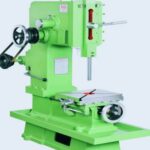
What is Shaper Machine?
A shaper machine, also known as a shaping machine, is a type
of metalworking machine tool that is used to produce flat surfaces and
irregular shapes by removing material from the workpiece with a cutting tool.
The cutting tool, called a shaper cutter, moves back and forth over the
workpiece in a reciprocating motion, removing material as it goes.
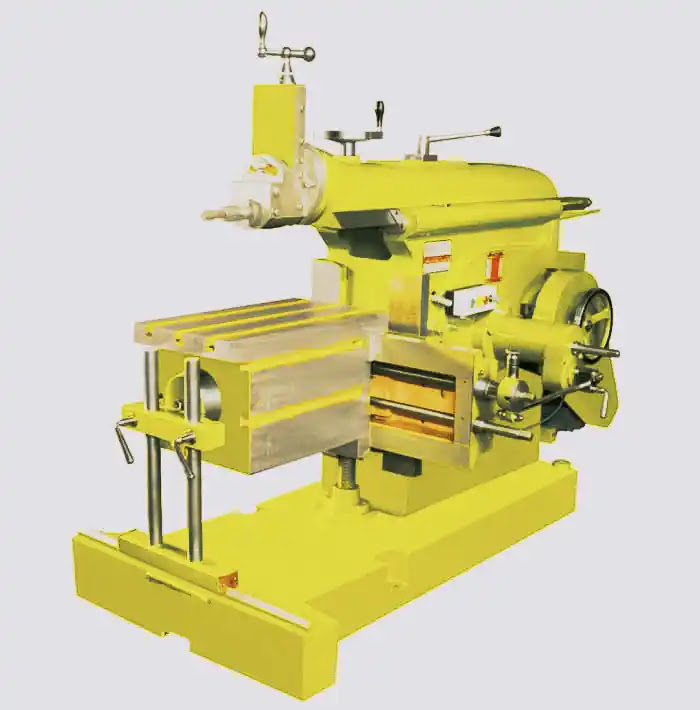
Shaper machines are typically made up of a base, a vertical
column, a horizontal cross rail, a tool head, and a worktable. The workpiece is
clamped onto the worktable, and the tool head, which holds the shaper cutter,
moves along the cross rail and over the workpiece in a reciprocating motion.
Shaper machines can be used to machine a wide range of
materials, including metal, wood, plastics, and composites. They are often used
in the manufacturing of metal parts, such as gears, pulleys, and machine tool
components.
Shaper machines come in different sizes and types, such as
standard shapers, universal shapers, and vertical shapers. They can be operated
manually or automatically, and some shaper machines are equipped with computer
numerical control (CNC) systems for greater precision and efficiency.
Shaper Machine
A shaper
machine is a type of machine tool used for shaping metal or other materials. It
is used to cut flat or curved surfaces on a workpiece using a single-point cutting
tool that moves back and forth on a horizontal or vertical plane.
The shaper
machine consists of a base, column, reciprocating table, cutting tool, and
drive mechanism. The workpiece is clamped onto the reciprocating table, which
moves back and forth in a linear motion while the cutting tool moves in a
perpendicular direction to cut the workpiece.
The
cutting tool is mounted on the tool head, which is moved by a motor. The tool
head can be rotated to cut at different angles, and the depth of cut can be adjusted
by moving the tool head vertically. The shaper machine can be used to cut a
variety of materials, including metal, wood, and plastics.
Shaper
machines are widely used in manufacturing for shaping and cutting parts, such
as gears, cams, and keyways. However, they have been largely replaced by more
advanced and automated machines, such as CNC milling machines, which offer
greater precision and efficiency.
Classification of Shaper Machine
Shaper machines are also metalworking machine tools that are
used to produce flat surfaces and irregular shapes by cutting material off the
workpiece with a cutting tool. Shaper machines can be classified in the
following ways:
- According
to the type of shaper:
- Standard
shaper: has a single point cutting tool and a reciprocating motion. - Universal
shaper: can be used for both internal and external cutting by mounting the
workpiece on the shaper table or on a dividing head. - Vertical
shaper: has a vertical tool head and a horizontal workpiece table, used
for machining large and heavy workpieces.
- According
to the size of the shaper:
- Small
shaper: has a stroke length of up to 305 mm. - Medium
shaper: has a stroke length between 305 mm and 610 mm. - Large
shaper: has a stroke length of more than 610 mm.
- According
to the type of cutting stroke:
- Push
shaper: the cutting tool is pushed towards the workpiece. - Draw
shaper: the cutting tool is drawn away from the workpiece.
- According
to the type of workpiece:
- Metal
shaper: used for machining metal workpieces. - Wood
shaper: used for machining wood workpieces.
- According
to the degree of automation:
- Manual
shaper: operated manually by a worker. - Semi-automatic
shaper: partially automated with features like automatic feed rate
adjustment.
Fully automatic shaper: fully automated with
features like computer numerical control (CNC) and automatic tool changers.
Types
of Shaper Machine
There are
several types of shaper machines, each designed for specific applications. Here
are some of the most common types of shaper machines:
- Standard shaper machine: This
is the most common type of shaper machine, which has a horizontal cutting
stroke and is used to cut flat surfaces. - Vertical shaper machine: This
type of shaper machine has a vertical cutting stroke and is used to cut
curved or angled surfaces. - Crank shaper machine: This
shaper machine uses a crank mechanism to move the cutting tool back and
forth, making it suitable for heavy-duty cutting. - Geared shaper machine: This
shaper machine uses a gear system to move the cutting tool back and forth,
making it suitable for precision cutting. - Hydraulic shaper machine: This
shaper machine uses hydraulic power to move the cutting tool, making it
suitable for high-speed cutting and heavy-duty applications. - Universal shaper machine: This
shaper machine can be used for both horizontal and vertical cutting,
making it a versatile option for different types of applications. - Travelling head shaper
machine: This shaper machine has a traveling head that moves along the
workpiece, making it suitable for cutting long and narrow workpieces.
These are
just a few examples of the types of shaper machines available. Each type has
its own advantages and disadvantages, and the choice of machine will depend on
the specific application and requirements.
Use of Shaper Machine
Shaper machines are used for shaping and machining flat and
irregular surfaces on workpieces. Some common uses of shaper machines include:
- Machining
flat surfaces: Shaper machines are used to machine flat surfaces on
workpieces, such as the top and bottom surfaces of machine tool beds,
tables, and blocks. - Cutting
keyways and grooves: Shaper machines are used to cut keyways and grooves
in workpieces, such as the keyways in gears, pulleys, and shafts. - Machining
irregular shapes: Shaper machines can be used to machine irregular shapes
on workpieces, such as splines, slots, and dovetails. - Chamfering
edges: Shaper machines can be used to chamfer edges on workpieces, such as
the edges of machine tool beds and ways. - Threading:
Shaper machines can be used to cut internal and external threads on
workpieces, such as the threads on bolts and nuts.
Overall, shaper machines are useful in the manufacturing
industry for creating precise and accurate metal parts that require specific
shapes, sizes, and finishes.
What is
a Shaper Machine used for
A shaper
machine is used for shaping metal or other materials by cutting flat or curved
surfaces on a workpiece using a single-point cutting tool that moves back and
forth on a horizontal or vertical plane. The cutting tool removes material from
the workpiece to create the desired shape and finish.
Some of
the common applications of a shaper machine include:
- Cutting keyways and slots in
gears, pulleys, and other machine components. - Shaping flat surfaces on
workpieces, such as the top of a table or the base of a machine. - Cutting internal and external
gears. - Producing various types of
splines. - Shaping and contouring metal
parts for various applications.
Shaper
machines can be used for a variety of applications in different industries,
such as manufacturing, automotive, aerospace, and construction. While shaper
machines have been largely replaced by more advanced and automated machines,
they are still used in many industries where precision and control are
critical.
Main Parts of Shaper Machine:
The main
parts of a shaper machine include:
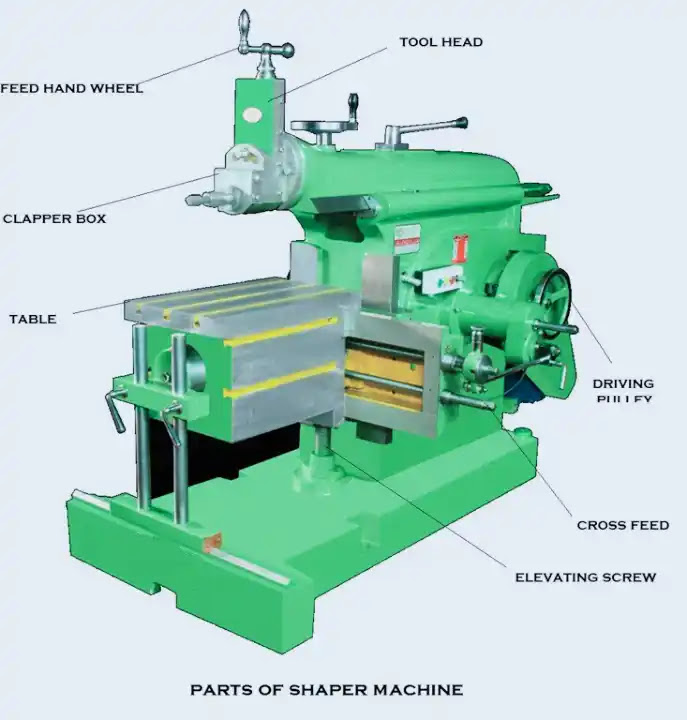
- Base: The base is the
foundation of the shaper machine and supports all the other parts. - Column: The column is a
vertical member that supports the reciprocating motion of the cutting
tool. - Reciprocating mechanism: The
reciprocating mechanism is responsible for moving the cutting tool back
and forth. - Table: The table is a flat
surface that supports the workpiece during the cutting process. - Cross slide: The cross slide
is a mechanism that allows the table to move perpendicular to the cutting
stroke. - Tool head: The tool head is
mounted on the column and holds the cutting tool. - Ram: The ram is a horizontal
beam that supports the tool head and moves it back and forth. - Clapper box: The clapper box
is a mechanism that allows the cutting tool to lift off the workpiece
during the return stroke. - Feed mechanism: The feed
mechanism controls the rate at which the workpiece is fed into the cutting
tool. - Drive mechanism: The drive
mechanism powers the reciprocating motion of the cutting tool and the feed
mechanism. - Lubrication system: The
lubrication system ensures that all moving parts of the machine are
properly lubricated to reduce friction and wear.
These are
the main parts of a shaper machine, although the specific design and
arrangement of these parts can vary depending on the machine.
Working
of Shaper Machine
The
working of a shaper machine involves the following steps:
- Clamping the workpiece: The
workpiece is clamped onto the table using clamps or vises. - Mounting the cutting tool: The
cutting tool is mounted on the tool head, which is attached to the ram. - Adjusting the tool position:
The position of the cutting tool is adjusted by moving the ram along the
column and the tool head across the cross slide. - Starting the machine: The
machine is started, and the cutting tool begins to move back and forth. - Cutting stroke: During the
cutting stroke, the cutting tool moves forward and cuts the material from
the workpiece. The feed mechanism controls the rate at which the workpiece
is fed into the cutting tool. - Return stroke: During the
return stroke, the cutting tool moves back to its starting position. The
clapper box lifts the cutting tool off the workpiece to reduce wear and
tear. - Repeating the cycle: The
cutting stroke and return stroke are repeated until the desired shape and
size of the workpiece is achieved.
The
cutting speed and depth of cut can be adjusted to achieve the desired finish
and accuracy. The quick return mechanism enables the cutting tool to move
quickly in one direction and return slowly in the opposite direction, which
helps to increase the cutting speed and productivity of the machine.
Once the
cutting process is complete, the workpiece is unclamped from the table, and the
cutting tool is removed from the tool head. The machine is then cleaned and
maintained to ensure optimal performance.
Quick
return Mechanism in Shaper Machine
The quick
return mechanism in a shaper machine is a mechanism that enables the cutting tool
to move quickly in one direction and then return slowly in the opposite
direction. This mechanism is used to increase the cutting speed and
productivity of the machine.
In a
standard shaper machine, the cutting tool moves forward on the horizontal plane
during the cutting stroke, and then returns to its starting position during the
return stroke. The quick return mechanism is designed to make the return stroke
faster than the cutting stroke.
The quick
return mechanism typically consists of a slotted lever, a connecting rod, and a
crank. The crank is driven by the motor and rotates the connecting rod, which
in turn moves the slotted lever. The cutting tool is attached to the slotted
lever, and as the lever moves back and forth, the cutting tool moves with it.
During the
cutting stroke, the connecting rod is at a small angle to the crank, which
results in a slow movement of the slotted lever and the cutting tool. During
the return stroke, the connecting rod is at a larger angle to the crank, which
results in a faster movement of the slotted lever and the cutting tool.
The quick
return mechanism in a shaper machine helps to reduce the machining time and
increase the efficiency of the machine.
Advantages
and Disadvantages of Shaper Machine
Advantages
of Shaper Machine:
- Versatile: A shaper machine is
versatile and can be used for a wide range of cutting operations,
including shaping, slotting, keyway cutting, and surface finishing. - Precision: A shaper machine
can produce accurate cuts with high precision, making it ideal for
applications where tight tolerances are required. - Cost-effective: Shaper
machines are relatively simple in design and construction, making them
cost-effective compared to other machining tools. - Ease of use: Shaper machines
are easy to operate and do not require highly skilled operators, which can
help to reduce labor costs. - Customization: A shaper
machine can be customized to meet specific cutting requirements, making it
a flexible tool for a wide range of applications.
Disadvantages
of Shaper Machine:
- Slow cutting speed: Shaper
machines have a slower cutting speed compared to other machining tools,
which can result in longer machining times. - Limited cutting depth: The
cutting depth of a shaper machine is limited, which can restrict the size
of workpieces that can be machined. - Manual operation: Shaper
machines are manually operated, which can make the machining process
labor-intensive and time-consuming. - Limited automation: Shaper
machines are less automated compared to other machining tools, which can
limit their productivity and efficiency. - Limited scope: Shaper machines
are not suitable for all types of cutting operations, and their scope is
limited to flat or curved surfaces.
Overall, a
shaper machine is a versatile and cost-effective machining tool that can
produce accurate cuts with high precision. However, its slower cutting speed
and limited cutting depth can restrict its use in certain applications.
Shaper
Machine operational procedure
The
operational procedure for a shaper machine involves the following steps:
- Inspection and preparation:
Inspect the machine for any damage or wear, and ensure that all necessary
tools and materials are available. - Clamping the workpiece: The
workpiece is clamped onto the table using clamps or vises. - Mounting the cutting tool: The
cutting tool is mounted on the tool head, which is attached to the ram. - Adjusting the tool position:
The position of the cutting tool is adjusted by moving the ram along the
column and the tool head across the cross slide. - Starting the machine: Turn on
the power supply and start the machine. - Adjusting the cutting speed
and depth of cut: Adjust the cutting speed and depth of cut as per the
requirements of the workpiece and the cutting tool. - Cutting stroke: During the
cutting stroke, the cutting tool moves forward and cuts the material from
the workpiece. The feed mechanism controls the rate at which the workpiece
is fed into the cutting tool. - Return stroke: During the
return stroke, the cutting tool moves back to its starting position. The
clapper box lifts the cutting tool off the workpiece to reduce wear and
tear. - Repeating the cycle: The
cutting stroke and return stroke are repeated until the desired shape and
size of the workpiece is achieved. - Inspection and finishing:
Inspect the workpiece for accuracy and finish. If necessary, repeat the
cutting process to achieve the desired result. After the work is
completed, switch off the machine, remove the workpiece, and clean the
machine.
It is
important to follow all safety precautions and guidelines while operating a
shaper machine, including wearing appropriate protective gear and ensuring that
the workpiece is securely clamped to the table. Always read the manufacturer’s
instructions and guidelines before operating the machine.
Difference
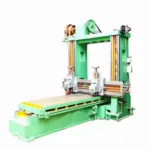
between Shaper Machine and Planer Machine
The main
differences between a shaper machine and a planer machine are as follows:
- Size: Planer machines are
generally larger and more powerful than shaper machines, and are used for
heavy-duty machining operations. - Workpiece size: Planer
machines can handle larger workpieces than shaper machines. - Cutting direction: In a shaper
machine, the cutting tool moves in a reciprocating motion along a vertical
or horizontal axis, whereas in a planer machine, the workpiece moves back
and forth along a horizontal bed, while the cutting tool remains
stationary. - Cutting speed: Planer machines
have a higher cutting speed than shaper machines, which makes them more
suitable for large-scale production. - Accuracy: Planer machines are
generally more accurate than shaper machines, as they have a more rigid
structure and can handle heavier loads. - Cost: Planer machines are more
expensive than shaper machines, as they require a larger and more complex
structure and have a higher power requirement.
Both
shaper machines and planer machines are used for shaping and finishing surfaces
on workpieces, but they differ in their size, cutting direction, cutting speed,
accuracy, and cost. The choice between a shaper machine and a planer machine
depends on the size and type of workpiece, the required finish and accuracy,
and the production volume.
Shaper Machine Mechanism
A shaper machine is a type of machining tool that is used to
create flat surfaces or profiles on a workpiece. The machine uses a
reciprocating cutting tool that moves back and forth across the workpiece to
remove material.
The basic mechanism of a shaper machine consists of the
following components:
- Base:
The base is the foundation of the machine and provides support to all the
other components. - Table:
The table is mounted on the base and is used to hold the workpiece. It can
move in three directions: up and down, back and forth, and left and right. - Ram:
The ram is mounted on the table and holds the cutting tool. It can move up
and down to adjust the depth of the cut. - Tool
head: The tool head is mounted on the ram and holds the cutting tool. It
can rotate to change the angle of the cut. - Drive
mechanism: The drive mechanism is used to power the machine and move the
cutting tool back and forth across the workpiece. - Clapper
box: The clapper box is mounted on the tool head and holds the cutting
tool. It can pivot to allow the cutting tool to move back and forth across
the workpiece.
The working of a shaper machine involves the following
steps:
- The
workpiece is placed on the table and secured in place. - The
cutting tool is mounted on the tool head and adjusted to the desired angle
and depth of cut. - The
drive mechanism is activated, and the cutting tool moves back and forth
across the workpiece. - The
cutting tool removes material from the workpiece, creating a flat surface
or profile. - The
clapper box allows the cutting tool to move freely and avoid damage. - The table
can be adjusted to create different profiles on the workpiece.
Shaper machines are commonly used in manufacturing
industries for creating flat surfaces, keyways, and dovetails on a workpiece.
Shaper Machine Diagram:
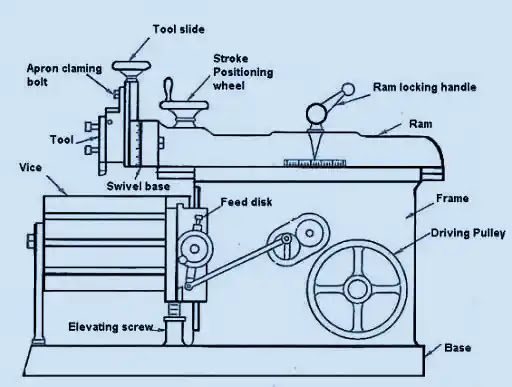
Size of
Shaper Machine
Shaper
machines come in a range of sizes, from small benchtop machines for hobbyists
and small-scale machining operations, to larger industrial machines for
heavy-duty production work. The size of a shaper machine is typically determined
by the size of the workpiece that it can handle and the cutting stroke length.
The
smallest shaper machines can have a cutting stroke length of around 150 mm (6
inches), while larger machines can have a stroke length of up to 1 meter (40
inches) or more. The size of the table and the maximum distance between the
table and the cutting tool also varies depending on the size of the machine.
Small benchtop machines may have a table size of around 200 mm x 300 mm (8
inches x 12 inches), while larger machines can have a table size of several
square meters.
The size
of the shaper machine is an important consideration when selecting a machine
for a particular application. The size of the machine should match the size of
the workpiece and the required cutting stroke length, and the machine should be
capable of handling the weight and load of the workpiece. Additionally, larger
machines may require a larger workspace and more power, so it is important to
consider the available space and power supply when selecting a shaper machine.
Read More: Milling Machine: Definition, Parts, Operation, Working Principle, Application, Advantages
Application
of Shaper Machine
Shaper
machines are used for a variety of applications in manufacturing and machining
operations. Some common applications of shaper machines include:
- Shaping flat surfaces: Shaper
machines are used to create flat surfaces on workpieces, such as the tops
and bottoms of engine blocks, gears, and machine bases. - Shaping contoured surfaces:
Shaper machines can also be used to shape curved or contoured surfaces on
workpieces, such as the contours of turbine blades and impellers. - Keyway cutting: Shaper
machines can be used to cut keyways, slots, and grooves in workpieces,
such as keyways in gears and pulleys. - Internal shaping: Shaper
machines can be used to shape the inside of a workpiece, such as the
inside of a cylinder. - Chamfering and beveling:
Shaper machines can be used to create chamfers and bevels on workpieces,
such as chamfers on engine blocks and bevels on gears. - Broaching: Shaper machines can
be used to broach workpieces, such as the teeth of gears. - Texturing: Shaper machines can
be used to create textured or patterned surfaces on workpieces, such as
textured surfaces on jewelry and decorative items.
The
versatility of shaper machines makes them useful in a wide range of industries,
including automotive, aerospace, manufacturing, and construction.
Read More: Planer Machine: Definition, Parts, Working Principle, Types, Operation, Advantages, Application