What is Planer Machine?
A planer machine, also known as a planer, is a type of
metalworking machine tool that is used to produce flat surfaces by cutting
material off the workpiece with a cutting tool. The workpiece is clamped onto a
horizontal bed in the machine, and the cutting tool moves back and forth over
the surface of the workpiece, removing material as it goes.
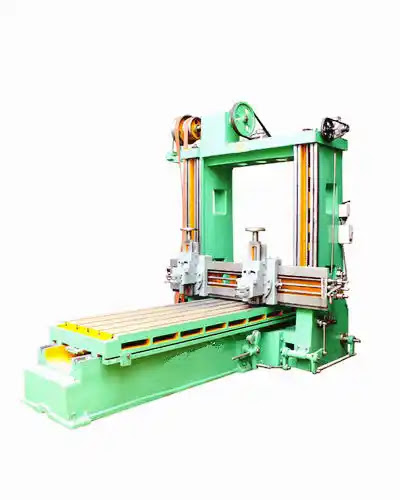
Planers are often used in the manufacturing of large metal
parts such as machine tool beds, ways for lathes and milling machines, and
large castings for engine blocks and other components. They can also be used
for woodworking, particularly in producing flat surfaces on large panels of
wood.
Planers can be operated manually or automatically, with the
cutting tool being driven by an electric motor or a hydraulic or pneumatic
system. They can also be fitted with digital readouts and other automation
features to improve accuracy and efficiency.
Planer Machine
A planer machine is a type of metalworking machinery that is
used to shape and surface flat or straight surfaces on large and heavy
workpieces. It is a stationary tool that consists of a cutting tool, a
worktable, and a guiding mechanism for the workpiece.
The cutting tool, known as the planer head, is mounted on a
horizontal cross rail that moves back and forth over the worktable. The
workpiece is held on the table and is guided through the cutting tool by a
series of feed rollers.
The planer head can be adjusted to remove a specific amount
of material from the workpiece, and the feed rollers can be adjusted to control
the speed at which the workpiece is fed through the machine. The cutting tool
is typically made from high-speed steel and can be sharpened or replaced when
it becomes dull.
Planer machines are commonly used in the metalworking
industry for large-scale machining operations, such as creating flat surfaces
on castings, forgings, and welded structures. They are also used in the
woodworking industry to create flat and straight surfaces on large pieces of
lumber.
Overall, planer machines are powerful tools that are capable
of removing large amounts of material in a short amount of time, making them
ideal for heavy-duty industrial applications.
Classification of Planer Machine
Planer machines can be classified in various ways, depending
on their design, size, and application. Here are some common classifications:
- According
to the type of planer:
- Double-housing
planer: has two columns supporting the cross rail and the tool head. - Open-side
planer: has one column and an open side to allow for machining larger
workpieces. - Edge
planer: used for machining the edges of large workpieces.
- According
to the size of the planer:
- Small
planer: has a bed length of up to 3 meters. - Medium
planer: has a bed length between 3 and 6 meters. - Large
planer: has a bed length of more than 6 meters.
- According
to the type of motion:
- Horizontal
planer: has a horizontal bed and a tool head that moves back and forth
along the length of the bed. - Vertical
planer: has a vertical bed and a tool head that moves up and down along
the height of the bed.
- According
to the type of workpiece:
- Metal
planer: used for machining metal workpieces. - Wood
planer: used for machining wood workpieces.
- According
to the degree of automation:
- Manual
planer: operated manually by a worker. - Semi-automatic
planer: partially automated with features like automatic feed rate
adjustment. - Fully
automatic planer: fully automated with features like computer numerical
control (CNC) and automatic tool changers.
Types of Planer Machine
There are several types of planer machines used in the
metalworking industry. Some of the most common types include:
- Double
Housing Planer: This is the most commonly used type of planer machine. It
is designed to handle heavy-duty applications and has a large worktable
and two housing columns for added stability. - Open-Side
Planer: This type of planer machine is designed for machining large and
bulky workpieces that cannot be accommodated on a regular planer. The open
side of the machine allows the workpiece to be loaded and unloaded easily. - Pit
Planer: This planer machine is designed to machine large and heavy
workpieces that cannot be loaded onto a regular planer machine. The
machine is sunk into a pit, allowing the workpiece to be placed on the
machine at ground level. - Edge
Planer: This type of planer machine is used for machining the edges of
workpieces to create flat and smooth surfaces. The machine has a single
column and a worktable that moves back and forth, allowing the workpiece
to be fed through the machine. - Rotary
Planer: This is a specialized type of planer machine used for machining
curved surfaces on workpieces. The machine has a rotary cutting head that
moves over the workpiece, removing material as it rotates.
These are just a few of the many types of planer machines
available in the metalworking industry. The type of machine used depends on the
specific application and the size and shape of the workpiece.
Planer Machine Working Principle
The working principle of a planer machine involves the
removal of material from a workpiece to create a flat or straight surface. The
machine consists of a cutting tool, a worktable, and a guiding mechanism for
the workpiece.
The cutting tool, also known as the planer head, is mounted
on a horizontal cross rail that moves back and forth over the worktable. The
workpiece is held on the table and is guided through the cutting tool by a
series of feed rollers.
The planer head can be adjusted to remove a specific amount
of material from the workpiece, and the feed rollers can be adjusted to control
the speed at which the workpiece is fed through the machine. The cutting tool
is typically made from high-speed steel and can be sharpened or replaced when
it becomes dull.
During operation, the planer head moves over the workpiece
and removes material in a straight line. The workpiece is fed through the
machine by the feed rollers, which move the workpiece at a predetermined speed.
As the cutting tool removes material from the workpiece, it
creates chips that are expelled from the machine. The workpiece continues to
move through the machine until the desired surface has been created.
Once the machining operation is complete, the workpiece can
be removed from the machine and inspected for accuracy and surface finish. If
necessary, the workpiece can be returned to the machine for additional passes
to achieve the desired results.
Overall, the working principle of a planer machine is
relatively simple, but it is a powerful tool that is capable of removing large
amounts of material in a short amount of time, making it ideal for heavy-duty
industrial applications.
Planer Machine Parts
A planer machine is a complex piece of machinery that is
made up of many different parts. Some of the main parts of a planer machine
include:
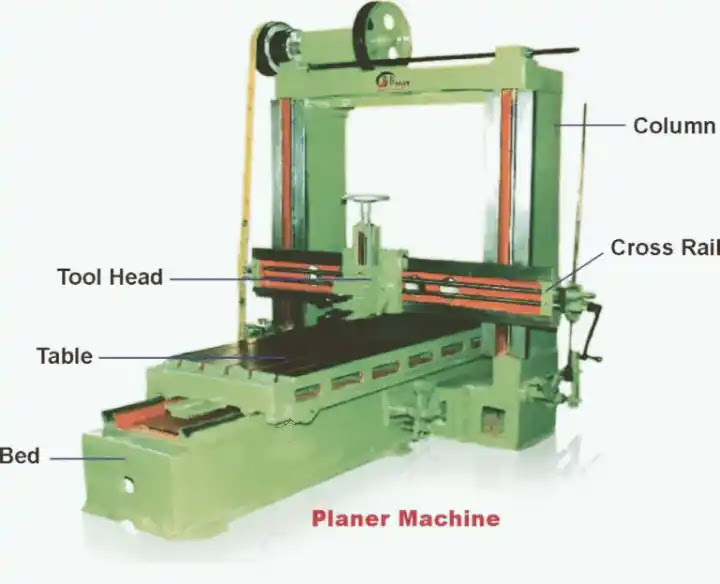
- Bed:
The bed is the main structure of the machine that supports all of the
other components. - Columns:
Columns are the vertical supports that hold the cross rail, which carries
the cutting tool. - Cross
Rail: The cross rail is a horizontal beam that moves back and forth over
the bed. It carries the cutting tool and is mounted on the columns. - Cutting
Tool: The cutting tool is a large, rectangular blade that is mounted in
the planer head. It removes material from the workpiece to create a flat
surface. - Feed
Rollers: The feed rollers are a series of small rollers that move the
workpiece through the machine at a predetermined speed. - Worktable:
The worktable is the surface on which the workpiece rests during
machining. It is adjustable in height and can be moved back and forth to
control the amount of material removed from the workpiece. - Bed
Ways: The bed ways are the flat, horizontal surfaces on which the
worktable slides. - Apron:
The apron is a protective cover that surrounds the cutting area of the
machine to prevent chips and debris from escaping. - Lubrication
System: The lubrication system is used to lubricate the moving parts of
the machine to reduce friction and wear. - Control
Panel: The control panel houses the machine controls, such as speed and
feed rate adjustments.
These are just a few of the main parts of a planer machine.
There are many other smaller components, such as gears, pulleys, and bearings,
that work together to create a powerful and precise machining tool.
Planer Machine Mechanism
The mechanism of a planer machine is relatively simple and
consists of several key components that work together to create a cutting
action. The following is a basic description of the planer machine mechanism:
- Bed:
The bed is the foundation of the machine and supports all of the other
components. - Worktable:
The worktable is mounted on the bed and supports the workpiece during the
machining process. It can be moved back and forth along the bed by a feed
screw mechanism. - Cross
Rail: The cross rail is mounted on the columns and moves back and forth
over the worktable. It carries the cutting tool and is driven by a drive
mechanism. - Cutting
Tool: The cutting tool is mounted on the planer head, which is attached to
the cross rail. It is a rectangular blade that removes material from the
workpiece as it passes over it. - Feed
Mechanism: The feed mechanism consists of a series of feed rollers that
are mounted on the worktable. They grip the workpiece and move it through
the cutting zone at a predetermined speed. - Drive
Mechanism: The drive mechanism is responsible for moving the cross rail
back and forth over the worktable. It is typically a motor-driven system
that operates on a reciprocating motion. - Lubrication
System: The lubrication system is used to lubricate the moving parts of
the machine, reducing friction and wear.
During operation, the workpiece is clamped to the worktable,
and the cutting tool is adjusted to remove a specific amount of material. The
feed rollers are then engaged, and the cross rail begins to move back and forth
over the workpiece, removing material with each pass.
The machine can be adjusted to vary the depth of cut, the
feed rate, and the speed of the cross rail. The lubrication system ensures that
the machine operates smoothly and with minimal wear.
Overall, the mechanism of a planer machine is relatively
straightforward but relies on precision engineering to produce accurate and
consistent results.
Planer Machine Application
Planer machines have a wide range of applications in various
industries, such as manufacturing, metalworking, and woodworking. Here are some
of the common applications of planer machines:
- Surface
Finishing: Planer machines are commonly used for surface finishing
applications, where a flat, smooth surface is required. They can remove
rough spots, high spots, or any other imperfections from the surface of
the workpiece. - Squaring
and Straightening: Planer machines can be used to square and straighten
large pieces of material. By removing a small amount of material from each
side of the workpiece, the machine can create a perfectly flat and square
surface. - Thicknessing:
Planer machines can also be used to thickness workpieces to a specific
dimension. They are commonly used in the woodworking industry to create a
consistent thickness across a piece of wood. - Shaping:
Planer machines can also be used for shaping applications, such as
creating bevels or chamfers on the edges of a workpiece. - Repair
and Restoration: Planer machines are often used for repair and restoration
work, such as restoring old or damaged wooden surfaces to their original
condition. - Production
of large machinery components: In the manufacturing industry, planer
machines are used to produce large machinery components such as machine
beds, columns, and housings.
Overall, planer machines are a versatile tool that can be
used for a wide range of applications. They are particularly useful for
creating flat surfaces and ensuring accuracy and consistency in large-scale
projects.
Advantages and Disadvantages of Planer Machine
Advantages of Planer Machine:
- Versatility:
Planer machines are versatile and can be used for a wide range of
applications, including surface finishing, squaring, straightening,
shaping, and thicknessing. - Accuracy:
Planer machines are designed to produce highly accurate and precise
results, ensuring that the finished product meets the required
specifications. - Efficiency:
Planer machines are capable of removing a large amount of material quickly
and efficiently, making them ideal for use in large-scale projects. - Durability:
Planer machines are built to withstand heavy use and can operate
continuously for long periods without requiring maintenance. - Cost-effectiveness:
Planer machines can be a cost-effective solution for many applications,
especially when compared to other machining tools.
Disadvantages of Planer Machine:
- Size
and Weight: Planer machines can be very large and heavy, making them
difficult to move and install. They require a significant amount of floor
space and may not be suitable for smaller workshops. - Noise
and Vibration: Planer machines can produce a lot of noise and vibration,
which can be a nuisance in a workshop environment. Proper safety measures
need to be taken to protect operators and the surrounding environment. - Limited
Flexibility: Planer machines are designed for specific applications, and
their capabilities may be limited compared to other machining tools. They
may not be suitable for certain projects that require a more specialized tool. - Complexity:
Planer machines can be complex and require skilled operators to ensure
they are used safely and effectively. The maintenance and repair of planer
machines may also require specialized knowledge and skills.
Overall, planer machines offer many advantages for a wide
range of applications. However, they also have some disadvantages that need to
be considered before investing in this type of equipment.
Read More: Milling Machine: Definition, Parts, Operation, Working Principle, Application, Advantages
Planer Machine Operation
The operation of a planer machine involves the following
steps:
- Set
Up: The workpiece is secured to the worktable using clamps or fixtures to
ensure that it is held firmly in place during the machining process. - Adjust
the Cutting Tool: The cutting tool is adjusted to the correct depth of
cut, feed rate, and speed of the cross rail for the specific application. - Lubrication:
The lubrication system is checked and filled to ensure that the moving
parts of the machine are well lubricated. - Power
Up: The machine is powered up and the feed rollers are engaged. - Start
the Machine: The cross rail starts moving back and forth over the
workpiece, removing material with each pass. - Monitor
the Process: The operator monitors the machining process to ensure that it
is running smoothly and that the machine is cutting to the desired
specifications. - Stop
the Machine: Once the machining process is complete, the machine is
stopped, and the workpiece is removed from the worktable. - Inspection:
The workpiece is inspected to ensure that it meets the required
specifications. - Repeat:
The process is repeated for additional workpieces until the job is
complete.
It’s important to follow proper safety procedures when
operating a planer machine. This includes wearing appropriate personal protective
equipment, ensuring that the workpiece is securely clamped to the worktable,
and being aware of the machine’s moving parts at all times. It is also
important to follow the manufacturer’s instructions and maintain the machine
regularly to ensure safe and efficient operation.
Read More: Shaper Machine: Definition, Parts, Working Principle, Types, Operation, Advantages, Application