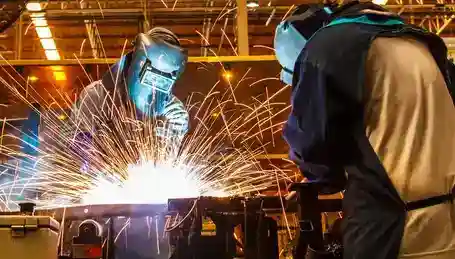
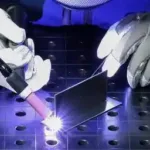
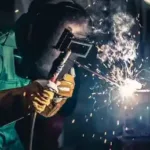
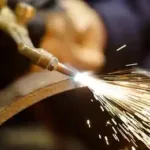
Welding is a process of joining two or more pieces of metal
or thermoplastics together by heating the surfaces to their melting point and
then allowing them to cool and solidify, which creates a strong, permanent bond
between the materials. Welding can be performed using different techniques such
as arc welding, gas welding, resistance welding, and laser welding. Welding is
used in a variety of industries such as construction, manufacturing, automotive,
and aerospace to create everything from large structures to small components.
It requires specialized training, equipment, and safety precautions to ensure a
successful and safe weld.
Types of Welding:
There are several different types of welding, each with its
own unique process, advantages, and applications. Here are some of the most
common types of welding:
Arc
welding: This type of welding uses an electric arc to melt and fuse metals
together. It is one of the most common types of welding and is used in
many industries.
Gas
welding: This method involves using a flame to heat and melt metal, then
adding a filler material to join the pieces together.
Resistance
welding: This type of welding uses electrical resistance to heat the metal
and join the pieces together.
TIG
welding: Tungsten inert gas (TIG) welding is a type of arc welding that
uses a tungsten electrode to heat and melt the metal, with an inert gas to
protect the weld from contamination.
MIG
welding: Metal inert gas (MIG) welding uses a wire electrode that is fed
into the weld pool, along with an inert gas to protect the weld from
contamination.
Laser
welding: This type of welding uses a high-powered laser beam to melt and
join metal parts together.
Plasma
welding: This is similar to TIG welding, but uses a plasma arc instead of
a tungsten electrode.
Electron
beam welding: This process uses a beam of high-energy electrons to join
metal parts together in a vacuum.
The choice of welding method depends on factors such as the
type of metal being welded, the thickness of the material, and the desired
strength and appearance of the weld.
Health and safety during Welding:
Welding can be a hazardous process that poses several health
and safety risks. It is important to follow proper safety procedures to protect
yourself and others in the vicinity. Here are some of the key health and safety
considerations during welding:
Respiratory
protection: Welding produces fumes and gases that can be harmful if
inhaled. Respirators, such as air-purifying respirators or powered
air-purifying respirators, should be worn to prevent exposure to these
hazards.
Eye
protection: Welding produces intense light that can cause eye damage.
Welders should wear appropriate eye protection, such as welding helmets or
goggles, with proper shade lenses.
Skin
protection: Welding can produce intense heat and sparks, which can cause
burns and other injuries. Welders should wear protective clothing,
including fire-resistant clothing, gloves, and aprons, to protect against
these hazards.
Ventilation:
Adequate ventilation should be provided in the welding area to remove
fumes and gases from the work environment.
Fire
prevention: Welding can produce sparks and flames that can ignite
combustible materials. Welders should take precautions to prevent fires,
such as removing flammable materials from the work area and having a fire
extinguisher nearby.
Electrical
safety: Welding equipment uses high voltage electricity, which can be
dangerous if not handled properly. Welders should follow proper electrical
safety procedures, including grounding the equipment and using insulated
gloves and tools.
Noise
protection: Welding can produce loud noise, which can cause hearing
damage. Ear protection, such as earplugs or earmuffs, should be worn to
prevent exposure to high levels of noise.
By following proper health and safety procedures, welders
can protect themselves and others from the hazards associated with welding.
Welding tools or Equipment
Welding requires specialized equipment and tools to create
strong and durable welds. Here are some of the most common tools and equipment
used in welding:
Welding
machine: This is the main piece of equipment used in welding. It generates
an electric current that creates the heat needed to melt and fuse the
metal pieces together.
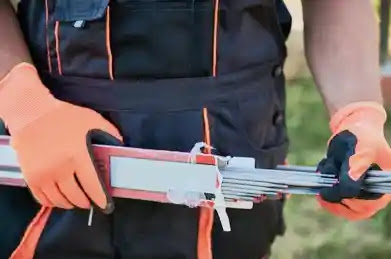
Welding
electrode: This is a metal rod or wire that is used to provide the filler
material for the weld.
Welding
helmet: This is worn to protect the welder’s face and eyes from the
intense light and radiation produced during welding.
Welding
gloves: These gloves protect the welder’s hands from the heat, sparks, and
radiation produced during welding.
Welding
jacket: This is a protective jacket worn to protect the welder’s body from
the heat and sparks produced during welding.
Welding
table: This is a table used to hold the metal pieces in place during
welding.
Wire
brush: This is used to clean the metal surfaces before welding to remove
any dirt, rust, or debris.
Chipping
hammer: This is used to remove the slag (the non-metallic coating that
forms on the surface of the weld) after welding.
Clamp:
This is used to hold the metal pieces together during welding to ensure
they stay in place.
Gas
cylinder: This is used to provide the shielding gas needed to protect the
weld from contamination.
These are some of the most common tools and equipment used
in welding, but there are many others depending on the specific type of welding
being performed.
Maintenance of Welding Equipment:
Proper maintenance of welding equipment is crucial to ensure
safe and efficient operation. Here are some general tips for maintaining
welding equipment:
Regular
inspections: Conduct regular inspections of your welding equipment to
ensure that it is in good condition and functioning properly.
Clean
the equipment: Clean your welding equipment regularly to remove any dirt,
debris, or welding slag that may have accumulated on the equipment.
Lubricate
moving parts: Lubricate moving parts of your welding equipment regularly
to ensure smooth operation and prevent wear and tear.
Check
for loose connections: Check for loose connections or damaged cables, and
replace them if necessary.
Replace
worn parts: Replace any worn or damaged parts of your welding equipment,
such as worn welding tips or damaged cables.
Store
equipment properly: Store your welding equipment in a clean, dry, and
protected location to prevent damage from moisture, dust, or other
environmental factors.
Follow
the manufacturer’s instructions: Always follow the manufacturer’s
instructions for maintenance, use, and storage of your welding equipment.
By following these maintenance tips, you can help ensure
that your welding equipment is in good condition and operating safely and
efficiently.
What is Welding Joint
A welding joint is the area where two or more metal pieces
are joined together using welding techniques. The type of welding joint used
depends on the welding process being used, the material being welded, and the
application of the welded part.
There are several types of welding joints, including:
Butt
joint: This is a joint formed by placing the two pieces of metal side by
side and welding them along the joint.
Lap
joint: This is a joint formed by overlapping the two pieces of metal and
welding them along the overlapping section.
T-joint:
This is a joint formed by placing one piece of metal perpendicular to the
other piece and welding them together along the joint.
Corner
joint: This is a joint formed by placing the two pieces of metal
perpendicular to each other and welding them at the corner.
Edge
joint: This is a joint formed by welding the edge of one piece of metal to
the surface of the other piece of metal.
The type of welding joint used depends on the requirements
of the application and the characteristics of the metal being welded. The
welding joint must be designed and prepared carefully to ensure that the weld
is strong and durable.
Welding position
Welding position refers to the orientation of the welding
joint in relation to the welder. There are four basic welding positions:
Flat
position: This is the most common welding position, where the welding
joint is horizontal and the welder works from above.
Horizontal
position: In this position, the welding joint is in a horizontal plane,
and the welder moves along the joint.
Vertical
position: In this position, the welding joint is vertical, and the welder
works from the bottom up.
Overhead
position: This is the most difficult welding position, where the welding
joint is overhead, and the welder works from underneath.
Each welding position has its unique challenges and requires
specific techniques and skills to produce a strong and high-quality weld. The welding
position used depends on the type of joint being welded, the material being
used, and the requirements of the application.
An electrode is a metal wire or rod that is used to conduct
electrical current to create a welding arc. It is one of the most critical
components of the welding process. The electrode is made of the same material
as the metal being welded and is coated with a flux material.
The flux coating on the electrode serves several purposes,
including:
Shielding
the weld from the surrounding air to prevent oxidation and contamination.
Providing
a protective gas that helps to stabilize the welding arc.
Providing
a cleaning agent that helps to remove any impurities from the weld.
Providing
additional filler material to the weld.
There are different types of electrodes available, depending
on the welding process and the type of metal being welded. Some common types of
electrodes include:
Stick
electrodes: These are used in shielded metal arc welding (SMAW) and are
the most commonly used type of electrode.
Tungsten
electrodes: These are used in tungsten inert gas (TIG) welding and are
made of tungsten, which has a high melting point and resists heat damage.
Flux-cored
electrodes: These are used in flux-cored arc welding (FCAW) and have a
flux core that provides shielding and additional filler material.
The choice of electrode depends on the type of metal being
welded, the welding process being used, and the desired welding results. The
selection of the right electrode is essential for producing a strong and high-quality
weld.
There are several types of welding electrodes available, and
the type used depends on the welding process and the material being welded.
Here are some of the most common types of electrodes:
Stick
electrodes: Stick electrodes, also known as shielded metal arc welding
(SMAW) electrodes, are the most commonly used type of electrode. They are
available in different types, including low-hydrogen, cellulose, and iron
powder. The choice of stick electrode depends on the type of metal being
welded and the desired welding results.
Tungsten
electrodes: Tungsten electrodes are used in tungsten inert gas (TIG)
welding and are made of pure tungsten or a tungsten alloy. They have a
high melting point and resist heat damage.
Flux-cored
electrodes: Flux-cored electrodes are used in flux-cored arc welding
(FCAW) and have a flux core that provides shielding and additional filler
material. They are available in different types, including self-shielding
and gas-shielded.
Metal-cored
electrodes: Metal-cored electrodes are used in gas metal arc welding
(GMAW) and have a metal core that provides additional filler material.
They are used for welding thicker materials and can provide faster welding
speeds.
Carbon
electrodes: Carbon electrodes are used in carbon arc welding and plasma
arc welding. They are made of graphite and are used to produce high heat
for welding and cutting.
The choice of electrode depends on the type of metal being
welded, the welding process being used, and the desired welding results. It is
essential to select the appropriate type of electrode to produce a strong and
high-quality weld.
Welding defects are flaws or imperfections that occur during
the welding process. These defects can weaken the weld, reduce its strength,
and compromise the integrity of the welded part. Some common welding defects
include:
Porosity:
This is caused by the presence of gas pockets or voids within the weld.
Porosity weakens the weld and can lead to cracks and failures.
Cracks:
Cracks can occur due to a variety of factors, including poor joint design,
incorrect welding parameters, or inadequate preparation of the weld.
Undercutting:
Undercutting occurs when the weld metal is not properly fused to the base
metal, resulting in a groove or depression in the weld.
Incomplete
fusion: This is caused when the weld metal does not fuse completely to the
base metal, resulting in a weak and unreliable joint.
Overlap:
Overlap is a condition where the edges of the metal being welded do not
come together properly, resulting in an uneven and weak joint.
Burn-through:
Burn-through occurs when too much heat is applied to the metal being
welded, causing it to burn or melt through the metal.
Preventing welding defects requires proper preparation,
technique, and equipment. It is essential to use the appropriate welding
process, electrode, and welding parameters for the type of metal being welded.
Inspecting the weld after completion and performing non-destructive testing can
help detect and identify any defects. Proper training and experience are also
crucial in preventing welding defects.
Here are some common causes and remedies for welding
defects:
Porosity:
Porosity is caused by gas pockets or voids within the weld. The most
common causes of porosity are inadequate shielding gas, contaminated
welding surfaces, and improper filler metal selection. Remedies include
proper gas shielding, cleaning the welding surfaces, and selecting the
appropriate filler metal.
Cracks:
Cracks can be caused by several factors, including poor joint design,
incorrect welding parameters, or inadequate preparation of the weld.
Remedies include improving joint design, ensuring proper welding
parameters, and preparing the weld surfaces properly.
Undercutting:
Undercutting occurs when the weld metal is not properly fused to the base
metal, resulting in a groove or depression in the weld. This can be caused
by high welding currents or incorrect electrode angles. Remedies include
reducing welding currents and adjusting electrode angles.
Incomplete
fusion: This is caused when the weld metal does not fuse completely to the
base metal, resulting in a weak and unreliable joint. Incomplete fusion
can be caused by poor joint preparation or incorrect welding parameters.
Remedies include ensuring proper joint preparation and selecting
appropriate welding parameters.
Overlap:
Overlap is a condition where the edges of the metal being welded do not
come together properly, resulting in an uneven and weak joint. Overlap can
be caused by incorrect welding parameters or poor joint design. Remedies
include improving joint design and adjusting welding parameters.
Burn-through:
Burn-through occurs when too much heat is applied to the metal being
welded, causing it to burn or melt through the metal. Burn-through can be
caused by high welding currents or incorrect welding parameters. Remedies
include reducing welding currents and adjusting welding parameters.
Preventing welding defects requires proper preparation,
technique, and equipment. It is essential to use the appropriate welding
process, electrode, and welding parameters for the type of metal being welded.
Inspecting the weld after completion and performing non-destructive testing can
help detect and identify any defects. Proper training and experience are also
crucial in preventing welding defects.
আমি Md Shamim Hossain, TonBangla-এর প্রতিষ্ঠাতা। প্রযুক্তি, কম্পিউটার, প্রোগ্রামিং, প্রকৌশল ও শিক্ষামূলক বিষয় নিয়ে সহজ, তথ্যবহুল বাংলা কনটেন্ট তৈরি করি।