What is
N-type Semiconductor?
An N-type semiconductor is a type of semiconductor material
that has been doped with impurities that have more electrons in their outermost
energy level than the atoms of the semiconductor material itself. These
impurities are called donor impurities, and they can be elements from group 15
of the periodic table, such as phosphorus (P) or arsenic (As).
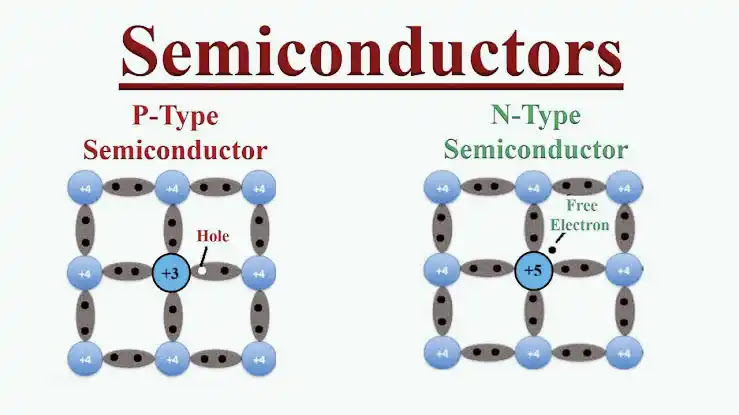
When the N-type semiconductor is doped with donor
impurities, extra electrons are introduced into the semiconductor crystal
lattice, which creates an excess of free electrons. These free electrons become
the majority carriers of electric charge in the material, and they contribute
to the material’s electrical conductivity.
In an N-type semiconductor, the majority carriers are
electrons, and the minority carriers are positively charged holes. When a
voltage is applied to the N-type semiconductor, electrons flow through the
material, creating an electric current.
N-type semiconductors are important in many electronic
devices, including transistors, solar cells, and light-emitting diodes (LEDs).
They are also used in digital and analog circuits, where they play a key role
in signal amplification and processing.